
For Gaurav Solanki, a home loan is more than a monthly bill. The Gurgaon-based IT professional is in his 50s. Retirement is only a few years away. He does
Solanki is willing to make sacrifices today to avoid that. He plans to cut back on discretionary spending and some investments. His priority is to repay the loan while he is still earning a regular salary.
“I have only a few years left in my professional career. I would rather pay a higher EMI now than carry a home loan into retirement. I may have to cut back on some investments, but becoming debt-free before I retire is a priority,” Solanki says.
For a younger borrower, the priorities are different.
Ashutosh Sharma, a 35-year-old salaried professional from Indore has two children and a household to support. School fees and everyday expenses already take up a share of the monthly income. A higher EMI could mean dipping into savings or cutting investments meant for the children’s education. It could also leave little money for emergencies.
“I want to repay my home loan, but I also have a family to support. I would rather extend the tenure than stretch my monthly budget so much that I have little left for emergencies or my children’s future,” the borrower says.
Both want to repay their loans. But Solanki wants to retire debt-free, while the younger borrower wants to keep monthly expenses under control.
This is a common when interest rates change. Following a change in the RBI’s repo rate hike to 5.50%, depending on the benchmark linked to the loan and the terms of the reset. Borrowers could then face a higher EMI, a longer repayment period or a combination of the two.
So, should you increase your EMI to repay the loan faster, or extend the tenure and pay interest for longer? The answer depends on how much you could save — and whether your monthly budget can comfortably absorb the change.
When interest rates rise, keeping the EMI unchanged may seem like the easier option. It avoids an immediate increase in monthly expenses, but the loan could remain outstanding for longer, adding to the total interest paid.
A home loan EMI covers both principal and interest. As the outstanding principal falls, the interest charged over the remaining loan period generally reduces. Paying off the principal faster can therefore lower the overall interest bill. Extending the tenure spreads repayment over more years and keeps the loan outstanding for longer.
Aswini Bajaj, CEO of Leveraged Growth, says increasing the EMI is usually the cheaper option over the long term, provided the borrower can comfortably afford the higher payment.
“If you increase your EMI, you repay that outstanding amount faster, so the bank has less principal to charge interest on over time,” he says.
“Extending the tenure instead means the loan stays outstanding for more years. That means you keep paying interest for longer, which can make the total cost of the loan much higher.”
Bajaj explains this through an example. Consider a borrower with a Rs 50 lakh home loan and 20 years remaining at an interest rate of 8%. The monthly EMI is approximately Rs 41,822, with total interest payable of around Rs 50.37 lakh over the remaining tenure.
Now suppose the interest rate rises to 9% and stays there for the rest of the loan.
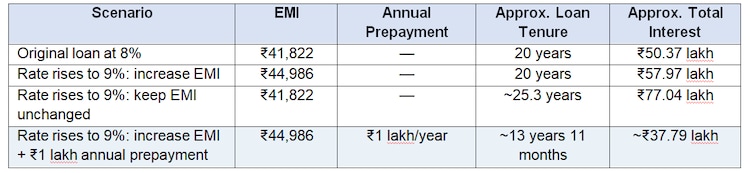
If the borrower increases the EMI to approximately Rs 44,986 and retains the 20-year tenure, the total interest outgo would be around Rs 57.97 lakh, says Bajaj.
But if the borrower continues paying the original EMI of Rs 41,822, the loan tenure could stretch to approximately 25 years and three months. The total interest outgo could rise to around Rs 77 lakh — roughly Rs 19 lakh more than under the higher-EMI option, Bajaj says.
These figures are illustrative and assume the revised interest rate remains unchanged throughout the remaining loan period. Actual costs will depend on the outstanding principal, the timing of the rate revision and the lender’s repayment calculations.
Nikhil Mawale, Co-Founder and CEO of PropertyDrone Realty, says borrowers who can comfortably afford a higher EMI should consider increasing their monthly payments to reduce the outstanding principal faster.
“If the higher EMI can be easily paid, increasing it will save more money in the long run. Borrowers also have the option to make prepayments if they have extra funds,” he says.
The caveat is affordability. Saving on interest may make financial sense over the long term, but not if the higher EMI leaves a household struggling to cover essential expenses or forces it to exhaust its savings.
For Srishti Oberoi, an advocate, the decision would depend on how much room he has in his monthly budget after meeting essential expenses.
He would prefer to increase her EMI if his income could comfortably absorb the additional payment, allowing him to repay the loan sooner and reduce the interest paid over time.
“I would like to increase my EMI if my monthly income is enough to handle the cost without any stress. This would let me pay off the loan sooner and save on interest over time,” he says.
But he would not want to pursue faster repayment at the cost of other financial responsibilities.
“If raising the EMI makes it hard to cover other monthly needs, then extending the loan period would be a better choice. The final decision depends on how much I spend each month, how much I save and what financial responsibilities I have. I want to save on interest. I also want to keep my family’s finances safe and stable,” he says.
For families with children, the trade-off can be particularly difficult. School fees, healthcare, everyday expenses and future education costs do not fall when a home loan EMI rises. A higher payment could reduce the money available for these needs or leave the family with little protection against an unexpected expense.
Indiresh N Phaltankar, Business Head–Retail Asset (Secured) at Federal Bank, says extending the tenure could help borrowers preserve their monthly cash flow and maintain financial flexibility.
“Extending the loan tenure can be a practical and financially prudent option for borrowers who wish to preserve monthly cash flows and maintain financial flexibility. A higher EMI helps repay principal faster, thereby reducing the overall interest outgo. The decision, however, depends on multiple factors, including the borrower’s income, existing commitments and financial comfort,” he says.
Mawale says borrowers should also consider their financial obligations, income stability and emergency funds before choosing a repayment strategy.
“If a borrower’s finances are tight, say due to high expenses related to children, healthcare, debt or an uncertain job, then it is important to keep loan EMIs within the borrower’s budget,” he says.
For such households, extending the tenure may be a reasonable way to avoid straining monthly finances. Having cash available for a medical emergency or a period without income may be more valuable than making additional interest savings today.
However, borrowers should understand the extra interest that a longer tenure could entail and review their repayment plans when their income improves or expenses fall. The aim should be to retain financial flexibility without allowing the loan to remain unnecessarily expensive for years.
According to Shashank Gupta, Director of RPS Group, before deciding what to do after an interest rate revision, borrowers should review their outstanding principal, revised interest rate, remaining tenure and the repayment options offered by their lender. They should then assess their income stability, monthly expenses, emergency savings and upcoming financial commitments.
Three broad approaches are worth considering:
Increase the EMI: This may suit borrowers with stable incomes and enough monthly surplus. It helps repay the principal faster and can reduce the overall interest burden.
Extend the tenure: This may suit borrowers whose budgets are stretched, whose incomes are uncertain or who face major expenses in the coming years. It offers immediate relief, although the total interest cost may rise.
Make partial prepayments: This may suit borrowers who have surplus funds after setting aside enough for emergencies, insurance and upcoming commitments. It can reduce the principal without permanently raising the EMI.
These choices need not be permanent. A borrower could extend the tenure during a period of financial pressure and increase the EMI later when income improves. Another could maintain a manageable EMI and use annual bonuses to make partial prepayments.
The decision should be based on the household’s financial position, rather than assumptions about when interest rates might rise or fall again.
For Solanki, the goal is to enter retirement without the burden of a home loan. He is willing to spend less today and cut back on some investments to make that possible.
For the younger borrower, financial security means keeping the EMI affordable while making room for children’s education, healthcare and emergencies, even if the loan takes longer to repay.
Neither approach is automatically right or wrong. A higher EMI can reduce interest costs when it is affordable. A longer tenure can provide breathing room when monthly finances are tight. Partial prepayments can offer a middle path for those with surplus funds.
The smartest repayment strategy is not necessarily the one that closes the loan fastest. It is the one that reduces debt without leaving a household financially vulnerable — today, through the years of repayment, and eventually in retirement.