
Not far from Sarita Vihar in southeast Delhi, the road takes you in the direction of the Yamuna. Most of it feels like New Delhi, till the road gets narrower and crowded: a clear sign of an older settlement still transitioning out of village vocabulary into the newness of the city.
This village, in the vicinity of the Yamuna, is Madanpur Khadar. Khadar translates to the fertile new alluvial belt by the river that is below the flood line. It is highly cultivable land and mostly surrounded by villages that work on this land.
When the British began making administrative strides in Delhi, this area came under their consideration. The British, around the 1850s, based their decision on issues such as caste or tribe, local influence, extent of landholding, services rendered to the state by a person or their family, and personal character and ability. So, they appointed a Zaildar from the Madanpur Khadar. The position was created so that local issues could be settled at the village-level, where the elderly headmen already had a hegemony over the people and was later also absorbed as member of the British jury.
Also read:
The Zaildars, who were like Chaudharis of the village, then took on this hereditary position to become the administration’s revenue officers, thus extending the influence of the colonial state into the villages.
This was an important decision for the British as this Zaildar would control a very large tract of land with several villages under them from the Yamuna to Mehrauli, which comprised over 28 villages. This position had such influence and power that the first Zaildar, this title was included in the official communication.
At the outset, Tirkha Ram Zaildar centralised the village by establishing a chaupal where elders sat through the day. It became an area for convening village gatherings and the centre for controlling the trade that was routed through Yamuna, with access to railway track connecting north and south India, something of great interest to the British. As the village administration began to be defined, several communities were brought into the scope, especially the fishing community of the river. The Zail was becoming a behemoth of an administrative district.
Also read:
The chaupal has clear colonial and pre-colonial north Indian architectural iconography. The courtyard with doric pillars framing the verandah of the single-storey structure are clear colonial signatures. The central niche has an old mirror still hanging above a fireplace.
In the central room, frescos and rich terrazzo with designs almost like a Kalamkari artist remain in places where nature and time has been kind. The wall recesses and a very ornate ceiling harken back to certain historic glory, especially against the rural backdrop of the Yamuna. An old fan crouching where a pankha must have been first installed serves as a fitting metaphor for what time does to old administrative structures; built with a vision for the future, yet forgotten as the past.
Also read:
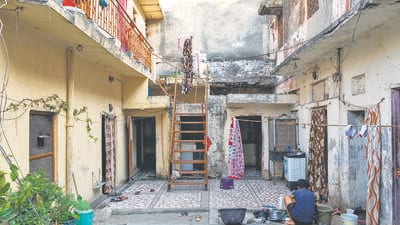
The Zaildar family settled in an over 200-year-old multi-storey haveli right behind the chaupal. Built in concrete and sandstone sealed with a combination of wood and stone, the building as it stands is now at its bones. The main family no longer lives there, but is a small commune of sorts, with many families renting the place. All ten rooms in this haveli have been occupied, and the families open their private quarters into the open courtyard, which is sealed with a metal grill on the first floor. Despite parts of it having fallen and become open to the elements, the residents cherish living in a historic place in a new city.
The chaupal and the Haveli both are at the very centre of the village; all houses circle this area and have done so even before the Zaildars. With this position based on caste and hierarchy, residents recount that even someone was cycling past the chaupal would often dismount as soon as they reached its threshold and walk across the area of the chaupal to respects to the village elders, most often convening over hookah (and meeting of Arya Samaj leaders).
The house of the family of the Zaildars is a few steps away from the centre of the old village. The family directly linked to Tirkha Ram Zaildar lives right in the front of the house, across two floors. The ground floor is completely contemporised but the first floor still holds the original construction of the 70s and 80s. With a grit finish, the structure has a brutalist exterior but an Indian interior. Some rooms have the latest furnishings, but others still have the good ol’ khaat.
The family did not forever remain loyal to British rule; they later turned dissenters. In one protest, the Zaildars blocked a railway line near the chaupal. When they discovered the halted train was carrying sugar, they dumped it into a nearby well. When the British asked for water and tasted its sweetness, they realized what had been done and conceded. With a past in British Service, the Zaildars were always for their community first. The family played an important role in 1947 and, during the partition, the staff of Jamia Milia Islamia took refuge in this chaupal. It became one of the main reasons for the family being elected as members of a corporation from Okhla constituency for four consecutive terms.
Just like sugar in the well, over time the history of the Zaildars of Madanpur Khadar has dissolved into the land, with only a few structures that keeping the memory alive. The family holds on to the portrait of Tirkha Ram Zaildar and as they transition into their future, refusoing to fade into history.
This article has been written with field support from Dilli Dehat, a project researching the history of villages of Delhi.
Anica Mann works on archaeology and contemporary art in Delhi. The views expressed are personal.