
The war in West Asia has triggered a global scramble for India’s oil market.
Russia wants to keep discounted crude flowing into Indian refineries to protect the revenues funding its wartime economy. Saudi Arabia is trying to recover market share lost to Moscow. The UAE wants to pump more oil and expand aggressively after breaking away from the OPEC+ alliance.
And the United States wants a larger strategic foothold in India’s energy basket as it pushes back against Russian influence in Asia.
As geopolitical tensions redraw global energy routes and long-term demand growth becomes harder to find, producers are competing for one of the few major markets where oil consumption is still rising rapidly.
That market is India.
For years, exporters dictated terms while importers worried about securing supply. Now the equation is beginning to shift. In a world where China’s demand growth is slowing, Europe is transitioning away from fossil fuels and future consumption forecasts are becoming increasingly uncertain, India has emerged as perhaps the most important growth market left in the global oil economy.
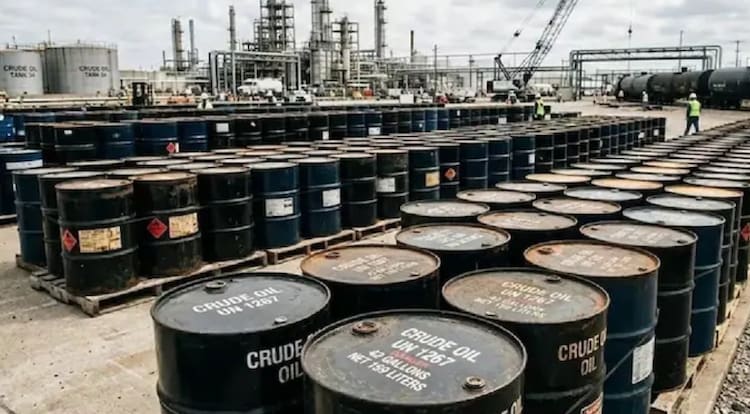
That is why everybody — from Moscow to Abu Dhabi to Washington — now wants a bigger piece of India’s oil market.
For most of the past two decades, global oil markets revolved around China’s industrial rise. But that equation is beginning to change.
China’s economic slowdown, weakening industrial demand and the rapid rise of electric vehicles have made future consumption growth far less predictable. Europe, meanwhile, is accelerating its transition away from fossil fuels. Even in the United States, long-term oil demand forecasts are becoming more cautious.
Oil producers are now confronting a difficult reality: the era of endlessly rising global demand may be nearing its peak.
Which is exactly why India matters so much.
India currently consumes and imports close to 90% of its crude requirements, according to data from the Petroleum Planning and Analysis Cell and the International Energy Agency (IEA).
The IEA has projected that India will account for one of the largest shares of global oil demand growth through the next decade, making it one of the few remaining large growth markets for exporters facing slowing demand elsewhere.
For producers staring at a more uncertain future elsewhere, India increasingly looks like the last giant growth market standing.
And everybody wants in before somebody else captures it first.
No country moved faster than Russia.
When Western sanctions shut Moscow out of much of Europe following the Ukraine war, Russian crude needed new buyers immediately. India stepped in at exactly the right moment.
Discounted Russian Urals crude began flooding Indian refineries. Indian refiners boosted purchases aggressively, attracted by cheaper cargoes and stronger refining margins. What initially looked like opportunistic buying soon evolved into a structural shift in India’s oil basket.
Today, Russia is India’s single largest crude supplier.
According to vessel-tracking data from Kpler, Russia retained its position as India’s largest crude supplier through the first four months of the year, accounting for roughly 40% of total imports and comfortably ahead of Iraq, Saudi Arabia and the UAE.
India’s crude basket has become far more diversified and fluid over the past three years. Russia remains the dominant supplier overall, though Iraq, Saudi Arabia and the UAE continue to compete aggressively for market share as refiners adjust sourcing strategies in response to sanctions, price movements and disruptions in West Asia.
Imports from Oman, the United States and African producers such as Angola have also risen periodically during phases of geopolitical volatility.
Russia initially captured the Indian market through steep discounts after Western sanctions shut Moscow out of Europe.
Cheap Russian barrels allowed Indian refiners to shield themselves from global price spikes while boosting export competitiveness for refined products such as diesel and aviation fuel.
But the relationship has since evolved beyond discounts alone.
Disruptions in West Asia and tighter global supplies have narrowed the gap between Russian crude and global benchmarks in recent months. News agency Reuters reported earlier this year that Russian Urals crude had at times traded at sharply reduced discounts — and even temporary premiums — in Asian markets as Gulf supply risks intensified.
Even so, Indian refiners have continued buying aggressively because Russian supplies are now deeply embedded in India’s refining ecosystem after three years of sustained trade.
And despite repeated Western pressure, India has shown little willingness to step away.
“We have been purchasing from Russia earlier, before waiver also, during waiver also, and now also,” Sujata Sharma, Joint Secretary in the petroleum ministry, .
“Whatever waiver or no waiver, it will not affect.”
Sharma added that India’s crude purchases were driven primarily by “commercial sense” and energy security considerations.
That position reflects how dramatically India’s leverage has grown in the global energy market.
A decade ago, large importers were often forced to navigate producer pressure and Western geopolitical expectations carefully. Today, India is large enough — economically and strategically — to prioritise its own energy security largely on commercial terms.
For Moscow, meanwhile, India has become indispensable.
Without India and China absorbing discounted crude, Russia’s oil revenues would have suffered far deeper damage under sanctions.
That dependence explains why Moscow has spent the past three years assembling shadow tanker fleets, building alternative payment mechanisms and offering pricing flexibility to Asian buyers.
Russia is no longer merely selling oil to India.
It is protecting one of the markets keeping its wartime energy economy alive.
The latest signal came from Abu Dhabi. The UAE formally exited the OPEC+ alliance — the grouping of the Organisation of the Petroleum Exporting Countries and allied producers led by Russia — on May 1, arguing that it needed greater flexibility to expand output.
UAE Energy Minister Suhail Al Mazrouei described the decision as a “sovereign strategic choice”, according to Reuters.
The move reflected a growing divide inside the oil-producing world over what matters more now: defending prices or defending market share.
For years, OPEC+ functioned around a simple principle — control supply tightly enough to keep prices elevated. But slowing demand growth in China, rising clean-energy adoption and uncertainty around future oil consumption are changing the incentives for producers.
Countries like Saudi Arabia still want disciplined output cuts to support prices. Others, including the UAE, increasingly appear more focused on securing long-term buyers while demand still exists.
India sits at the centre of that calculation.
The UAE is already among India’s largest crude suppliers. Now, freed from OPEC+ production constraints, Abu Dhabi wants to expand its footprint further in one of the world’s fastest-growing energy markets.
Russia’s rise has also deeply unsettled the Gulf producers that once dominated India’s energy imports.
Saudi Arabia, Iraq and the UAE spent decades positioning themselves as India’s most reliable suppliers. Then Russia arrived with discounted crude and disrupted the hierarchy almost overnight.
Now the Gulf is trying to regain lost ground.
But the strategy has evolved beyond simply competing on price.
Saudi Arabia and the UAE increasingly want deeper control over India’s downstream ecosystem through refinery stakes, petrochemical investments, storage infrastructure and long-term strategic partnerships.
Because this battle is no longer about this month’s cargoes. It is about locking in decades of future demand.
Whoever embeds themselves deepest inside India’s refining system secures long-term influence over one of the world’s fastest-growing energy markets.
That urgency has only intensified after the West Asia conflict exposed how vulnerable global shipping routes remain.
The Strait of Hormuz — through which a substantial share of India’s crude imports passes — once again became a geopolitical flashpoint after the Iran conflict disrupted regional energy flows.
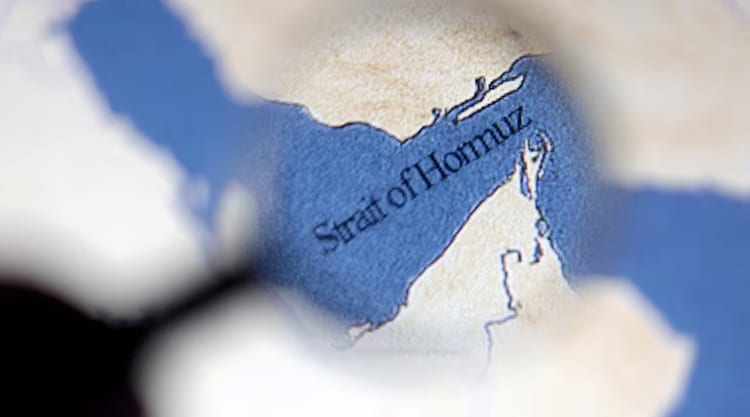
According to shipping and trade data tracked by Reuters, Indian refiners were forced to diversify cargo sourcing rapidly during periods of disruption, increasing purchases from Russia, Oman and other suppliers outside the immediate Gulf conflict zone.
That created fresh openings for everybody.
Russia positioned itself as a stable alternative outside the Gulf choke point. Saudi Arabia increased exports during periods of sanctions-related uncertainty around Russian supplies. The UAE accelerated plans to expand production and bypass Hormuz-linked vulnerabilities.
Everybody was competing to appear indispensable to India’s energy security.
Washington’s role in this story is often underestimated. The United States is not merely trying to sell more crude to India. It wants strategic influence over the future direction of Asian energy flows.
For the US, energy has become tied closely to a broader geopolitical contest involving trade, technology, supply chains and Indo-Pacific security.
Reducing Russia’s influence over India’s oil basket has increasingly become part of that calculation.
American crude exports to India remain smaller than Russian or Gulf volumes, but Washington clearly sees long-term strategic value in expanding the relationship.
Earlier this year, US officials privately encouraged Indian refiners to diversify purchases away from Russian crude amid renewed sanctions discussions, according to multiple reports on India-US energy negotiations.
Yet India has resisted aligning too closely with any single bloc.
Instead, New Delhi is balancing everybody simultaneously.
Buying Russian crude while strengthening ties with Washington. Expanding partnerships with Saudi Arabia and the UAE while preserving strategic autonomy. Leveraging competition among exporters to negotiate discounts, attract investments and diversify supplies.
That balancing act may now be India’s biggest geopolitical advantage.
The deeper story underneath the West Asia conflict is not simply about war or supply disruptions. It is about how the balance of power in global oil markets is beginning to change.
For decades, producers dictated the terms. Now buyers like India are gaining leverage because future demand growth is becoming harder to find.
That is why Russia is fighting to protect a market it captured after the Ukraine war. Why the UAE wants freedom to pump more outside OPEC+ constraints. Why Saudi Arabia is doubling down on investments in Indian energy infrastructure. And why the United States wants a bigger foothold in India’s energy market.