
A Reddit discussion on Bengaluru’s summer water crisis has raised concerns among homebuyers about the sustainability of apartment-led real estate growth, with users pointing to rising dependence on private water tankers, weak urban planning, and shrinking water resources as key risks to consider before buying a flat in the city. Here’s a checklist for prospective homeowners.
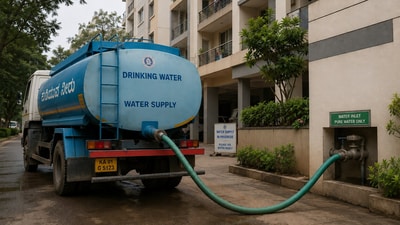
One Reddit user has criticised buyers purchasing expensive apartments without an assured water supply infrastructure.
“I live in a very green and livable part of the city with a Kaveri water connection, in a house bought 30 years ago. I’d never in my wildest dreams purchase an apartment for crores without basic necessities like water,” the user wrote.
The Redditor further argued that several homebuyers were purchasing properties in developing outskirts, banking on future infrastructure growth without accounting for long-term water availability.
“Folks like you are delusional to buy without a water connection outside the city in the name of airport and development,” the comment added.
Also Read:
Apartment growth, lake loss and tanker economy under scrutiny
Several Reddit users linked Bengaluru’s water stress to rapid apartment construction, shrinking lake systems and unchecked borewell extraction.
One of the Redditors wrote, “Bengaluru’s water crisis is worsening. Who do you think is responsible for this situation? Not only using it as sewage, but also closing of n-number of lakes and building huge apartments.”
The Redditor argued that large apartment complexes with multiple borewells and rising population density were sharply increasing pressure on already stressed groundwater resources.
Another user claimed Bengaluru was “never sustainable through apartment models given the poor or non-existent town planning,” adding that the private water tanker economy has flourished because apartments can collectively afford expensive tanker water supplies.
Several Redditors also blamed the conversion of lakes, rajakaluves and open land into residential and commercial projects for worsening groundwater recharge.
Rapid urban expansion strains water supply ahead of summer, say experts
Rapid urban expansion in Bengaluru has put increasing pressure on the city’s water resources, widening the gap between and demand. While several established localities receive piped water from the Cauvery River, many areas added to the city’s limits over the years continue to remain outside this network.
Urban experts note that in 2007, over 100 surrounding villages were brought under the city’s jurisdiction, including parts of Mahadevapura, Yelahanka, Bengaluru South, and RR Nagar. However, many of these rapidly developing zones, especially those around key IT corridors such as Whitefield and Sarjapur, still lack reliable access to piped water.
As a result, many newer residential areas depend on borewells and private water tankers. As groundwater levels continue to decline, these areas are becoming increasingly vulnerable to shortages, particularly during the summer months, experts say.
Also Read:
Bengaluru RWAs say this summer, things will ‘look better’
Resident welfare associations and apartment societies in Bengaluru believe water availability could improve this summer due to measures introduced by the Bangalore Water Supply and Sewerage Board, including expanded Cauvery tanker supply under Sanchari Kaveri and increased focus on rainwater harvesting.
Residents say better groundwater recharge after recent rains, coupled with conservation efforts by apartment complexes, may help the city avoid the severe shortages witnessed last year, particularly in areas within the Greater Bengaluru Authority limits.
Satish Mallya, president of the Apartment Federation, said apartment complexes within the limits of the Greater Bengaluru Area are unlikely to face the kind of severe water shortages witnessed last summer, largely due to improved access to BWSSB-supplied tanker water under the ‘Sanchari Kaveri’ initiative.
Sanchari Kaveri is a tanker-based water supply service operated by the Bangalore Water Supply and Sewerage Board to provide Cauvery water to areas facing shortages or lacking direct pipeline connections. The service became important during Bengaluru’s recent summer water crises, when several apartment complexes relied on tanker deliveries to supplement groundwater and borewell supply.
“Many apartment associations are now shifting away from private local tankers because BWSSB water is being supplied at lower rates compared to last year, reducing dependence on the informal tanker market that typically profits during shortages. Apartment federations are actively guiding residential societies to book BWSSB tankers in advance, helping stabilise supply across the city. However, he cautioned that areas beyond the Greater Bengaluru Authority limits could still face water stress due to weaker infrastructure and limited pipeline connectivity,” Mallya said.
(Disclaimer: This report is based on user-generated content from social media. HT.com has not independently verified the claims and does not endorse them)