
India’s investment pipeline has hit a significant milestone. The project stalling rate, measured as the value of stalled projects as a share of the total value of projects under implementation, declined to a 12-year low of 5.5% in FY26, down from nearly 11% in 2014-15.
While this has been gradually declining for the past six years, data from the project-tracking database of the Centre for Monitoring Indian Economy (CMIE) reveals that this execution cleanup was driven by the private sector. The project-stalling rate for private players plunged by nearly 700 basis points over the decade. In comparison, public sector stalling rates saw a more modest, though steady, decline from 5.9% to 2.5% during the same period.
Broad-based clearing
A further analysis showed that all the prominent segments have seen a decline in their project-stalling rate over a decade. However, a closer look at the last two fiscal years reveals some divergence among industries. Segments such as manufacturing, , non-financial services, and the construction and real estate sectors sustained a downward trajectory. Among these, saw an impressive decline, with its stalling rate shrinking from 9.5% to 6.9%, while other sectors notched marginal drops.
Sujan Hajra, chief economist and executive director at Anand Rathi Group, notes that India’s growth engine has increasingly shifted from goods to services in both domestic consumption and exports. While this explains why goods-heavy project pipelines saw elevated stalling over the past decade, he views the current revival in goods-sector execution as an expected correction.
Among the sectors, mining registered a slight jump in stalled projects.
Fewer stalled, abandoned, or shelved projects suggest that the execution pipeline is clearing. But does this headline optimism reflect a true investment recovery?
Experts urge caution. “The fall in the project stalling rate is encouraging, but it should not be over-interpreted,” notes Hajra.
He points out that the lower stalling rate aligns with other evidence of modest improvement in the capital expenditure cycle: strengthening bank credit growth, an above-average capacity utilization (75.6% in December 2025) and the strong composite Purchasing Managers Index print of 58.1 in May 2026. These indicators suggest India’s execution conditions have improved, even if the private investment cycle is not yet booming, he added.
The growth paradox
The improved project execution indicator comes at a time when there is a weaker appetite for investment in the economy. The CMIE data showed new project announcements fell nearly 2% in FY26, as against the 15% growth seen in the previous fiscal.
Manoranjan Sharma, chief economist at Infomerics Valuation and Rating, a credit rating agency, notes that while a lower project stalling rate reflects faster clearances, stronger monitoring, healthier banks, and improved infrastructure financing, it does not indicate a broad investment revival. “India is executing old projects better but not generating enough new ones, suggesting an ‘execution recovery’ rather than a full private investment cycle.”
Experts also point to greater political alignment between the Centre and most states, which has likely reduced execution friction.
Looming uncertainty
But with external shocks now dominating the horizon, is this execution recovery at risk? Heightened geopolitical uncertainty due to the ongoing West Asia war, which has triggered spikes in crude oil prices, threatens to stoke domestic inflation. This could result in risk aversion and can squeeze domestic liquidity, impacting core economic activity, consumption, and corporate expenditure.
“The West Asia crisis, and protectionist global trends can certainly hurt sentiment and delay projects. So, both new announcements and execution metrics may weaken in FY27 versus FY26,” says Hajra. “But unless these shocks become structural, they are unlikely to derail India’s longer-term investment trend.”
Historically, India’s project execution has proven to be highly sensitive to external shocks. During the covid-19 disruption, project stalling rates doubled from 10% in FY19 to 20% in FY20 before multi-year interventions kicked off the current decline.
The immediate concern is that nearly a third of all project stalling is typically triggered by a lack of funds, fuel or feedstock supply disruptions, and unfavourable market conditions, and the current global crisis could directly threaten to aggravate these vulnerabilities.
“The risk of reversal remains significant,” said Sharma of Infomerics. “Historically, project stalling rises during financing stress, commodity shocks, and demand uncertainty. Current risks—high crude prices, West Asia-linked shipping disruptions, sticky inflation, and tighter global liquidity—raise input costs, disrupt supplies, and weaken demand.”
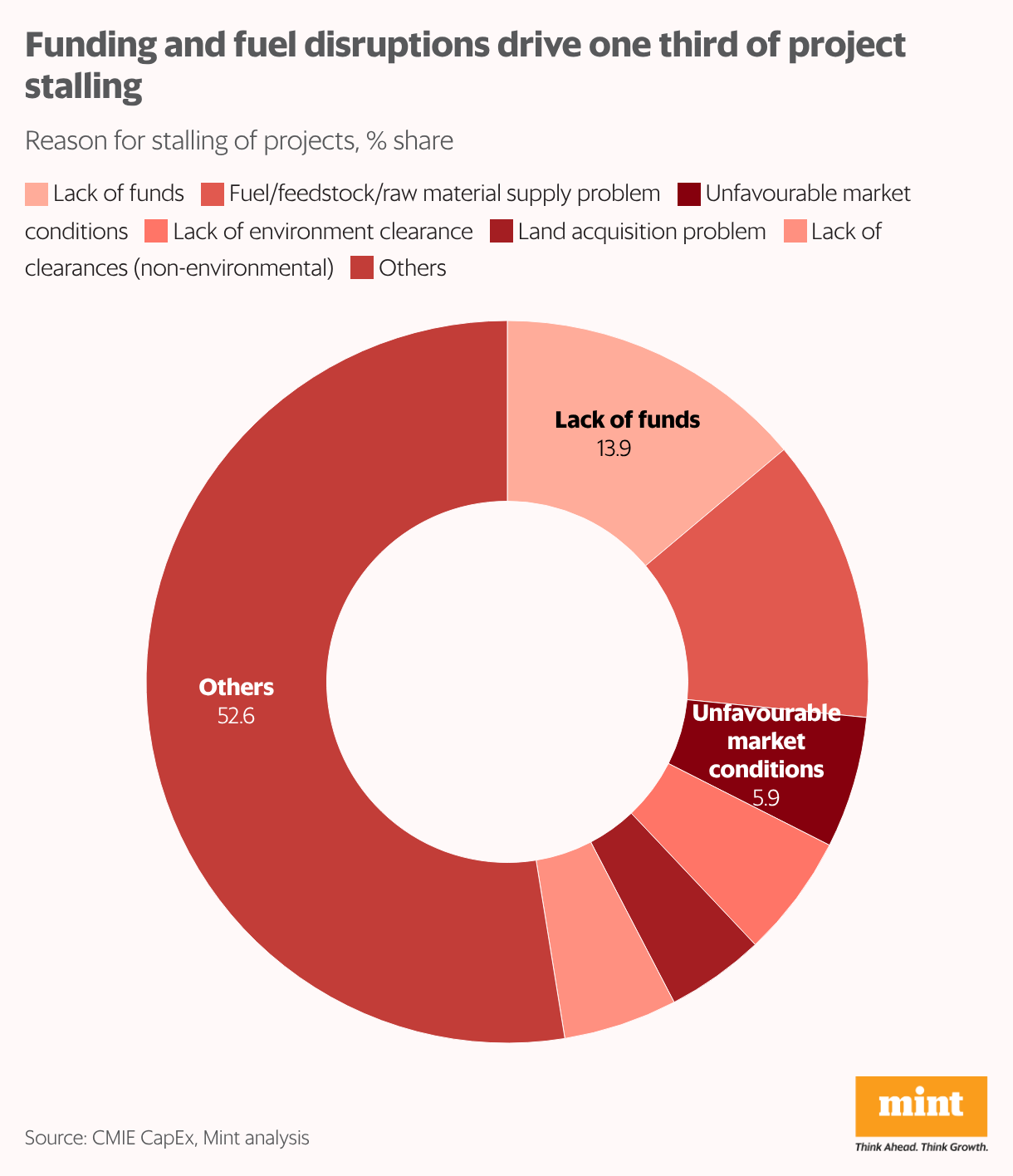
While a prolonged geopolitical volatility could again push up stalling of projects, a complete investment derailment is unlikely. That said, experts believe private capex will remain selective.
Ends