
A renewed focus on affordable housing, rental housing reforms, stronger homebuyer protection through better RERA–IBC alignment, and more effective implementation of RERA is essential for India’s real estate sector to achieve its projected size of $5.8 trillion by 2047, according to a joint report by KPMG in India and NAREDCO.
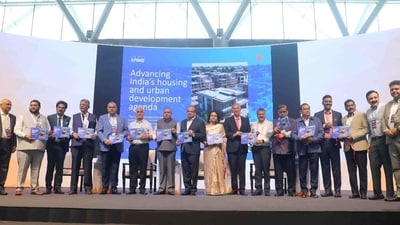
The report, ‘Advancing India’s Housing and Urban Development Agenda’, released by Union Housing and Urban Affairs Minister Manohar Lal Khattar at the NAREDCO Real Estate Conclave 2026 in New Delhi this week, recommended a series of measures to boost the supply of affordable housing for Economically Weaker Sections (EWS) and Low-Income Groups (LIG).
These include expanding land availability, increasing permissible Floor Area Ratio (FAR), streamlining approvals through single-window clearance systems, improving access to low-cost financing, and offering targeted tax incentives.
Unlocking affordable housing supply is the need of the hour
A key priority is the need to unlock affordable housing supply, particularly for Economically Weaker Sections (EWS) and Low-Income Groups (LIG). Structural constraints such as rising land costs, approval delays, fragmented regulatory processes and limited financial access continue to constrain viable project delivery in this segment.
Also Read:
The report highlights the importance of targeted interventions, including higher floor area ratio (FAR) for streamlined approvals through single-window systems, digitised land mapping and reduced development charges to improve project feasibility. Strengthening last-mile infrastructure and aligning master plans with real-time urban growth patterns are also seen as essential enablers.
“With urbanisation projected to reach 40 per cent by 2036 and nearly half our population living in cities by 2050, the decisions we make today, on housing, infrastructure, transit, technology and inclusive finance, are set to shape the quality of life for hundreds of millions of our fellow citizens. The sector’s potential to reach $5.8 trillion by 2047 and beyond, is not merely an aspiration. It is an obligation we need to rise to meet,” said Parveen Jain, national president, NAREDCO.
Rental housing should be formalised into a structured asset class
The report suggests that rental housing can be formalised into a structured asset class through measures such as GST rationalisation, inclusion under priority sector lending, conversion of vacant housing stock into rental assets, and development of co-living and segment-specific housing models for students, workers and senior citizens. Adoption of Affordable Rental Housing frameworks and public asset monetisation is expected to significantly expand supply.
Also Read:
To address rising demand for rental housing, it calls for a formal ecosystem supported by institutional investment, regulatory backing and innovative financing. Recommendations include expanding Affordable Rental Housing (ARH) models, converting vacant assets into rental stock, rationalising GST and creating dedicated frameworks for students, migrant workers, working women and senior citizens.
Rera-IBC alignment
The report also called for closer alignment between the Real Estate (Regulation and Development) Act (RERA) and the Insolvency and Bankruptcy Code (IBC) to better protect homebuyers in stressed projects. It recommended project-wise insolvency resolution, early-warning systems to identify financial stress, stronger coordination between RERA authorities and insolvency professionals, and enhanced safeguards for homebuyers during insolvency proceedings.
Highlighting RERA’s impact, the report noted that since its introduction, more than 1.65 lakh projects and 1.16 lakh real estate agents have been registered, while over 1.62 lakh complaints have been resolved across states and union territories.
Also Read:
“The real estate sector would be central to India’s development and called for stronger collaboration among government, industry and financial institutions to accelerate housing and infrastructure delivery,” said Jain.
“Enhanced RERA-IBC alignment and technology-driven monitoring systems could foster transparency, accountability and project execution. Further, raising the default threshold for initiating IBC proceedings to ₹5 crore could support efficient project progress,” said Neeraj Bansal, Partner and Head – India Global, KPMG in India.
As RERA nears a decade of implementation, the report recommends greater regulatory consistency, wider use of digital project-monitoring systems, faster enforcement of orders and increased awareness in Tier-II and Tier-III cities.