
As India’s cities continue to expand at a rapid pace, urban planning has become increasingly important to ensure growth remains sustainable, connected and inclusive. Rising migration, population growth and infrastructure demands have made it essential to develop future-ready urban centres rather than relying solely on the expansion of existing cities.
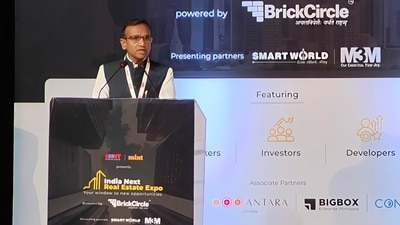
During a keynote address at the India Next Real Estate Expo organised by Hindustan Times, CREDAI national secretary Gaurav Gupta on Saturday shared his vision for the future of the National Capital Region (NCR). He highlighted the role of Namo Cities, the Regional Rapid Transit System (RRTS), Noida International Airport, affordable housing reforms and sustainable development in shaping the next phase of urban growth.
“The question before us is not whether NCR will grow—it will. The question is: how will it grow? Will it be haphazard, fragmented, and unsustainable? Or will it be planned, connected, affordable, and inclusive?” said the national secretary of CREDAI, the apex body of private real estate developers in India.
Gupta noted that NCR’s population has grown from nearly 3.7 crore in 2000 to over 7.8 crore today, making planned development more important than ever.
Namo cities: A new model of urban development
Calling the Centre’s Namo Cities vision a transformational step, Gupta said the initiative is aimed at creating new planned urban centres rather than expanding existing cities.
“This is not about expanding existing cities. This is about creating new, planned urban centres that distribute growth intelligently across the region.”
He added that these cities, strategically located around Haryana, Uttar Pradesh, Rajasthan and Delhi, will form a “Golden Ring of Opportunity” around the Eastern and Western Peripheral Expressways, helping reduce congestion while creating new economic corridors.
RRTS: Transforming regional connectivity
Gupta described improved connectivity as the backbone of future urban growth, pointing to the operational Delhi-Meerut RRTS corridor as an example of how infrastructure can reshape commuting patterns.
“With RRTS, a journey that once took more than 70 minutes now takes 25.”
He said the expanding metro network, expressways and freight corridors are bringing Tier-2 and Tier-3 cities closer to major economic hubs, ensuring development is spread across the region rather than concentrated in existing metros.
Noida international airport
Highlighting the significance of Noida International Airport, Gupta said the project will transform the regional economy by attracting investment, industries and residential development.
“An airport at this scale and location will function as a regional catalyst for comprehensive economic and infrastructural development.”
According to him, the airport is already driving infrastructure expansion through expressways, freight corridors, rapid transit and rail connectivity, while boosting residential and commercial projects along the Yamuna Expressway.
Affordable housing
Gupta expressed concern over the declining share of affordable housing, arguing that the existing ₹45 lakh price cap no longer reflects market realities.
“The definition of affordable housing, as established in 2019, is no longer practical.”
He urged the government to revise the policy by removing or increasing the price cap while retaining size restrictions so that benefits reach genuine homebuyers.
CREDAI Bharat mission
Speaking on sustainability, Gupta said urban development must go hand in hand with environmental responsibility.
“Building new cities is not just an economic opportunity—it is a responsibility we cannot delegate or postpone.”
Under the CREDAI Bharat Mission, more than 9,000 acres have already been identified for reforestation.
“For every residential unit sold by CREDAI developer members participating in this mission, thirty trees will be planted. Thirty trees per house. This means that as we build homes for Indians, we are simultaneously planting forests.”
He concluded by stressing that the future of Indian real estate lies in planned urbanisation, affordable housing, modern infrastructure and sustainable development working together to create greener, better-connected and more liveable cities.