India raises fertilizer subsidy by 64%, vastly overshooting budget estimates amid global price surge
India hikes fertilizer subsidy by 64% for 2026-27 Rabi, far exceeding budget estimates amid global price spikes.
1
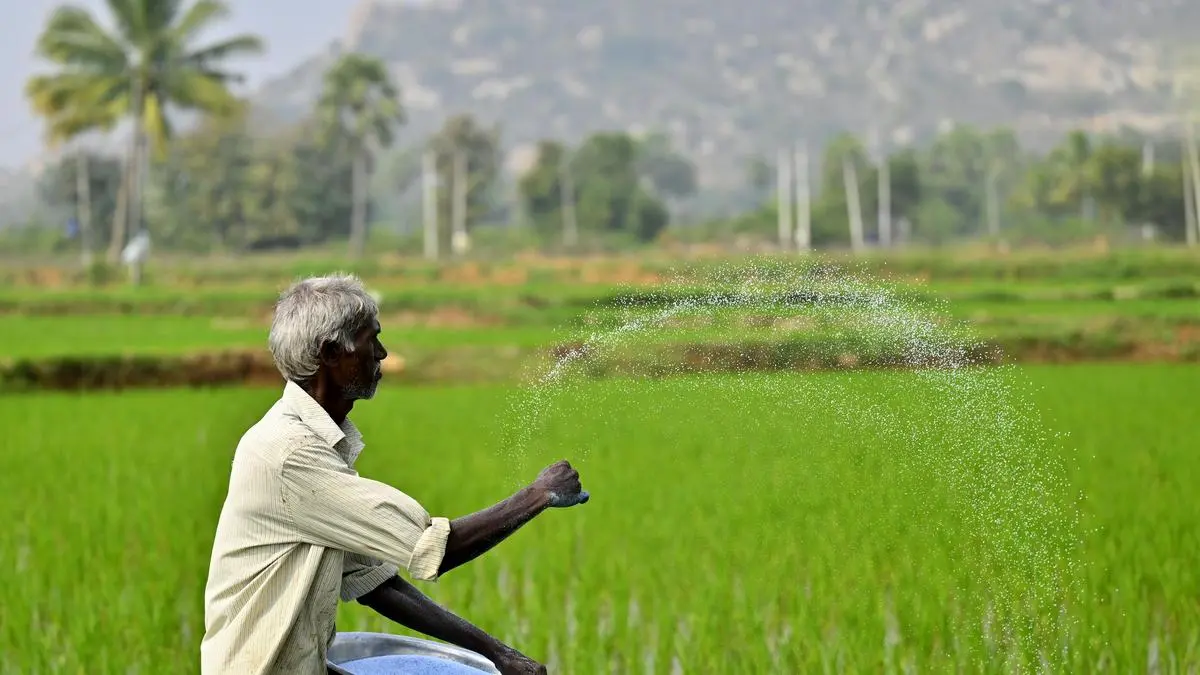
The Union Cabinet on Wednesday approved a ₹62,370.02 crore subsidy for different types of fertilizers for the 2026-27 Rabi season, which is ₹24,417.73 crore more than ₹37,952 crore budgeted for 2025-26 Rabi season. With ₹41,533.81 crore subsidy allocated for Kharif 2026, the total outgo and P & K subsidy in FY27 has exceeded ₹1 lakh crore mark, as against budgetary allocation of ₹54,000 crore.
As the government had budgeted ₹1.71 lakh crore total fertilizer subsidy including ₹1.17 lakh crore on urea for FY27, the overall outgo may top ₹3 lakh crore as global prices of both urea and LNG (key input for manufacturing) had also shot up after the Iran war and continued for a longer period.
The government had, in fact, cut fertilizer subsidy by over 8 per cent in FY27 from ₹1.86 lakh crore in FY26. But the Iran war, started from February 28, upended expectations of global easing of prices and the result is ballooning subsidy at the cost of fiscal prudence.
Total spending
Total spending on fertilizer subsidy in six months till September has already crossed 70 per cent of the FY27 budget estimates, according to Controller General of Accounts (CGA). It is estimated that total spending for FY27 could touch as high as ₹3.50 lakh crore. When the budget for fertilizer subsidy was lowered, it was said that there would be “reduced requirement for imported urea and P&K fertilizers leading to balanced use of fertilizer nutrients for better soil health and productivity.”
“The higher subsidy bill was expected given global developments on gas in particular. With food inflation rising sharply it is essential to check input costs like fertilizers. It is against this background we should look at higher subsidies. We believe fiscal deficit ratio will be higher up to 0.3 per cent if GDP and this increase has already been factored,” said Madan Sabnavis, Chief Economist, Bank of Baroda.
After the Union Cabinet approval for rabi season (from October 2026 to March 2027), the subsidy on nitrogen (N) will be ₹94.21 per kg against ₹47.32 per kg in kharif 2026 (April-September). Sulphur (S) subsidy has been raised to ₹10.42 per kg from ₹3.16 per kg and phosphorus to ₹66.11 per kg from ₹52.76 per kg. However, potash (K) subsidy has been constant at ₹2.38 per kg for the last few seasons.
Highlighting the increase in subsidy, which is paid to fertilizer companies to make available the crop nutrients at cheaper rates to farmers and keep costs of production under check, the government said that it was necessitated in view of recent trends in the international prices of fertilizers and inputs.
Enhanced outlay
The enhanced outlay comes against the backdrop of global fertilizer price volatility and disruptions arising from the West Asia crisis. The government said the package would ensure adequate availability of fertilizers during the rabi season, while keeping input costs stable for farmers.
Briefing media after the Cabinet meeting, Information and Broadcasting Minister Ashwani Vaishnaw said that the government has also approved a sulphur package for domestic manufacturers. Under this, manufacturers will receive 20 per cent of the actual procurement cost of sulphur and sulphuric acid. However, a floor price of $800 per tonne for sulphur and $266.67 per tonne for sulphuric acid have been fixed.
Stating that detailed guidelines will be issued by the Department of Fertilizers, he said the decision will help strengthen domestic production and reduce import dependence. Besides, it will promote the use of alternatives such as SSP in place of DAP and ammonium sulphate in place of urea, thereby encouraging balanced nutrient application.
The country’s total fertilizer stocks stood at 235.21 lakh tonnes (lt) as on November 10, 2026, against 173.46 lt on the corresponding date last year. Urea stocks were at 103.12 lt against 72.14 lt while DAP stocks rose to 28.65 lt from 24.86 lt. The complex fertilizers (combination of NPKS nutrients) stocks are also higher at 60.87 lt from 42.44 lt and those of MOP are nearly doubled to 20.08 lt from 10.78 lt. Only SSP stocks, were marginally lower at 22.49 lt against 23.24 lt.
Fertilizer demand
Based on the feedback received from States, the Centre has estimated the fertilizer demand in current rabi season at about 350 lt – Urea 199.27 lt, DAP 55.07 lt, MOP 16.4 lt and Complex 79.12 lt.
“Announcing the NBS subsidy well ahead of sowing helps companies to plan import and supply DAP, MOP, SSP and Complex fertilizers in time as it removes uncertainty, though the government keeps assuring to bear the difference between actual cost and its intended selling prices,” said a CEO of a fertilizer company.
Though as per policy fertilizer companies are independent to fix the retail price of DAP, the government has been insisting them not to sell the 50-Kg bag above ₹1,350 and accordingly the subsidy on ‘P’, the main component of DAP, has been revised each season as per global prices.
The government will continue special provisions beyond the NBS framework to ensure DAP is available at ₹1,350 per bag and these provisions have also been extended to imported and domestic TSP and imported MAP.
The freight subsidy on SSP and the subsidy on imported and domestic ammonium sulphate will also continue during the Rabi season.
Describing the Cabinet approval as timely and positive, S Sankarasubramanian, Chairman, Fertilizer Association of India (FAI), said: “The enhanced support will help ensure adequate availability of P&K fertilizers at affordable prices, promote balanced plant nutrition and provide an important impetus to domestic production.”
Source: BusinessLine Economy
Disclaimer: This article is for general information and does not constitute investment, tax or legal advice. Markets and rates change; please verify with official sources or a qualified professional before you act.