Quarter of India’s labour force highly exposed to AI, says report
A new study shows nearly a quarter of India’s workforce is highly exposed to AI, with 7.6% gaining productivity and 11.4% facing substitution risk.
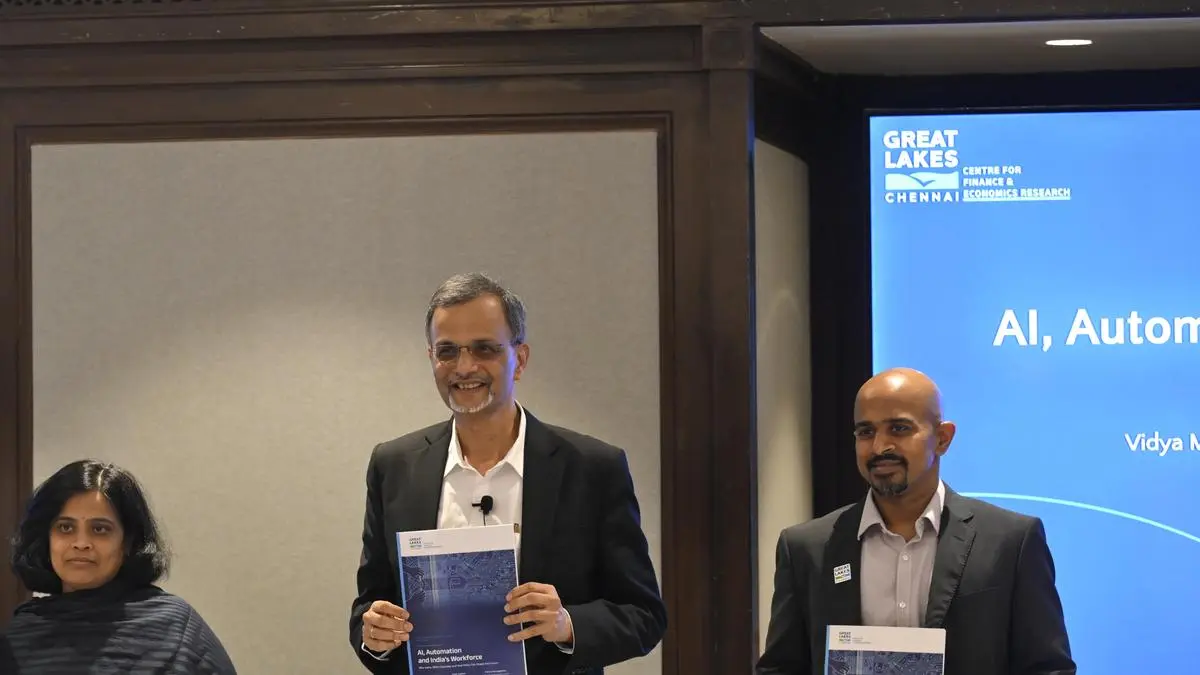
In one of the first such studies of the impact on AI on Indian workforce using India’s own labour data, a new report finds that nearly a quarter of the country’s labour force is engaged in work that is ‘highly exposed’ to AI.
The analysis from the Centre for Finance and Economic Research, Great Lakes Institute of Management took into account data from the Periodic Labour Force Survey (PLFS).
The higher exposure to AI can have both complementary and substitution effects depending on the job profile with 7.6 per cent of the workforce expected to see increased productivity, while 11.4 per cent may face substitution risk.
However, in a plus, occupations such as agriculture as well as skilled trades — who together account for 54.4 per cent of India’s workforce — face relatively low substitution risk — both from AI or conventional machine driven automation.
The report is authored by Vidya Mahambare, Vivek Jadhav, and Vishnu Venugopalan.
Unveiling the report at an event here on Sunday, V Anantha Nageswaran Chief Economic Advisor, Government of India noted that the task before policymakers is to improve the quality of existing exposure through AI literacy, task redesign, and reskilling.
AI for productivity
Writing in the report’s foreword, the CEA said that employment in high-routine occupations that are susceptible to conventional automation and mechanisation regardless of what happens with AI, has risen by 4.8 percentage points since 2012. AI now competes for routine tasks, he said, stressing that the window to reskill and learn how to use AI for productivity is open.
Health, elderly care, education and the skilled trades, and other non-routine, high-complementarity occupations are areas where India needs more workers, he adds.
Meanwhile, the report mentioned that the share of people in occupations with more substitution risk is higher for younger employee cohorts — at 39.4 per cent in the 15–24 age group. In fact the 15-24 cohort have the worst ratio in terms of high-routine jobs to complementary jobs at 7.6 to 1 against roughly 4 to 1 for every older cohort.
As for the specific States, Maharashtra, Haryana, Kerala and Tamil Nadu have the highest shares of workers in AI-complementary occupations to build on.
As policy recommendations, the report suggested expanding AI literacy and reskilling, particularly for young workers.
“Prioritise young, urban labour-market entrants, the unemployed and those in routine clerical, back-office and low-discretion technical roles for training in judgement, verification, and client engagement,” it said. Also target new AI-induced jobs such as data annotators and AI trainers, it noted, among other recommendations.
Source: BusinessLine Economy
Watch: The truth behind India's GDP calculation #indianeconomy #data
Watch: Is India’s $4 Trillion GDP Actually a Trap? | Economic Case Study
Disclaimer: This article is for general information and does not constitute investment, tax or legal advice. Markets and rates change; please verify with official sources or a qualified professional before you act.