
Few figures are as deeply imprinted into the built fabric of Delhi as Sir Sobha Singh, fondly remembered as “aadhi Dilli ka maalik”. His rise from a sub-contractor to one of the principal builders of imperial Delhi is inseparable from the making of the city itself. In 1903, while engaged in the Kalka–Shimla railway, he was summoned by Edwin Lutyens to undertake what would become one of the most ambitious architectural projects in India: the construction of Rashtrapati Bhavan. The task was urgent, complex, and tied to the symbolic deadline of the Delhi Durbar of 1911. From this moment onward, Sobha Singh’s legacy would expand across Delhi and beyond.
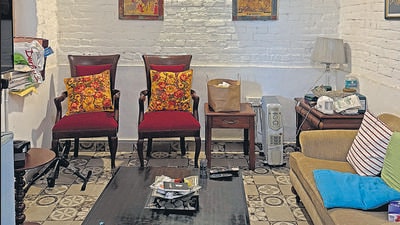
It was during the construction of Rashtrapati Bhavan that Sobha Singh recognised the necessity of establishing a permanent base in the Capital. The house he built for himself in central Delhi, both residence and office, stands today just as it was built. Drawing from the architectural language shaped by Lutyens, the house preserves an early 20th century domesticity that remains remarkably intact.
The entrance is its most striking feature. Marked by a deliberate monumentality, it echoes the visual vocabulary associated with imperial Delhi, including the work of Walter Sykes George. A defining motif here is the circle, an aniconic form, “pure” in its refusal to represent anything beyond itself. This same formal language can be seen across the city, most famously in India Gate and in several institutional buildings that bear the imprint of Lutyens’ vision and Sobha Singh’s execution. The house, in this sense, is not merely a residence but an extension of a larger architectural ideology.
The planning of the house reflects a time when movement and arrival were ceremonially structured. A carriage entrance leads into the property, suggesting a life once organised around horse drawn mobility. Adjacent pathways and sheltered resting areas for carriages evoke a slower rhythm of living, one where architecture accommodated not just habitation, but transition.
Inside, the house feels suspended in time. Much of it remains unchanged, save for the occasional coat of paint. The office, located along the edge of the property, retains its original layout: Sobha Singh’s desk, portraits of him and his wife, the fireplace with its brass detailing, and the roshandaans that filter light into thick walled interiors. The terrazzo flooring, framed like a carpet, anchors the room, while side tables, windows, and outdoor pelmets continue to hold their place. This was a space that transitioned seamlessly from administrative work during the day to evening gatherings with the colonial administration.
Daily life here carried its own rituals. At 7:30 pm sharp, drinks were served. Sobha Singh and his wife, Varyam Kaur, would host guests in the drawing room, where social etiquette and cultural exchange unfolded. Varyam Kaur, known for her progressive outlook, played a crucial role in shaping this environment. She encouraged her husband to learn English, even if it meant practising on bicycle rides, and embraced the social codes of the time with curiosity and grace. Her characteristic greeting, “Helloji,” captures a moment of cultural translation, where colonial formality met local adaptation.
Adjacent to the office lies a deeply personal yet architecturally significant space: a private domestic gurdwara. It features an outer sitting area leading into an inner prayer hall through double doors marked by geometric and aniconic patterns. The original kundi still secures the entrance. Inside, skirting lines the walls, allowing devotees to sit in comfort. Framed by Lutyens-style pillars, the sanctum incorporates a terrazzo embedded Nishan Sahib, merging sacred symbolism with the material language of the house. A Lutyen’s style wooden corner cupboard for the holy texts complete this intimate spiritual complex.
Nearby, guest houses were built to accommodate visiting granthis. These structures, modest yet thoughtfully planned, include a drawing room, enclosed verandah, bedroom, trunk room, and utility areas. Today, their peeling plaster reveals the brick beneath, but aside from minimal maintenance, they remain untouched, preserving the spatial logic of their time.
What makes this house compelling is not just its association with a prominent historical figure, but its value as an architectural study. It reveals how colonial design principles were translated into domestic spaces, how symbolism and utility coexisted, and how a builder like Sobha Singh inhabited the very language he helped construct across the city.
As a three-time chairman of the New Delhi Municipal Council, Sobha Singh’s influence extended beyond individual buildings to the governance and shaping of urban Delhi. Yet, within this house, one encounters a more intimate narrative of ambition, adaptation, and the quiet endurance of form.