
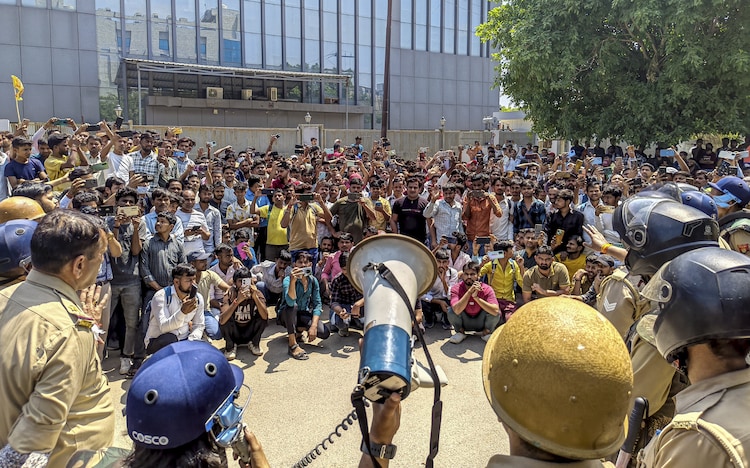
The ongoing unrest in Noida, where worker protests escalated into clashes and arson, has once again brought the spotlight on labour conditions and enforcement gaps in India’s manufacturing sector.
What unfolded on the streets was not an isolated breakdown. It reflects a deeper pattern—one that has long been visible within factory gates, but rarely acknowledged.
I have seen this pattern up close. I was assigned, on a random basis, a special inspection of a factory owned by a public limited company manufacturing automotive products. What I found was not unusual, but it was revealing.
It showed how employers not only blatantly evade compliance, but also design systems to circumvent labour laws, often with tacit accommodation from the enforcement machinery.
And everything was in plain sight.
A routine inspection conducted earlier had failed to report several critical violations. The inspection was so cursory that the officer did not even sign the statutory inspection register before leaving.
More strikingly, he recorded that a deputy general manager, who had resigned nearly three years earlier, was functioning as the manager at the time.
My inspection revealed that eight workers in carpentry, eight in road and sanitation work, seven in loading and unloading, and four in painting—a total of 27 workers—had been kept outside the legal framework.
When confronted, the General Manager promptly issued a written assurance that all of them would be brought under the Act.
The factory sourced its security personnel through an agency registered under the Employees’ State Insurance (ESI) Act.
At some point, ownership of this agency was transferred to an individual. While such transfers are not unusual, scrutiny of wage records revealed that the new owner was the company’s own Security Officer.
Such arrangements are rarely accidental. They are structured to blur accountability while retaining effective control.
I recommended that the matter be examined to determine whether the agency could genuinely continue to be treated as an independent legal entity under the Act.
In another instance, an inspector reviewing financial records of this company for 1983-84 concluded that although significant investments had been made in expanding capacity, introducing new products, and constructing a new building, the new structure had no connection with the existing factory.
On that basis, he held that the workers engaged in its construction were not covered under the Act.
My on-site assessment suggested otherwise.
The new building stood adjacent to the main factory within the same compound. On enquiry, it was clarified that the building was intended to house machine tools, research and development, and electronics units previously located elsewhere.
In my report, I asserted that the workers involved in its construction were indeed coverable under the law.
In fact, based on the earlier inspection report, the Regional Office had directed the factory to furnish wage details paid since February 1, 1981, under the heads of “building construction and repairs.”
This direction had not been complied with. The conclusions in the latest inspection report must be viewed in that context.
The structuring of non-compliance extended well beyond the factory premises. The inspector had reported that workers employed through contractors in an area covered by the Act—but located outside the factory—were not coverable, as their work was not supervised by the principal employer or his agent.
I insisted on visiting the site personally and was eventually able to do so, accompanied by an officer of the company.
The area was an industrial estate owned by the principal company, enclosed by a compound wall with a single entry point.
The premises had been leased to 17 contractors, while security was handled by another contractor engaged by the same company.
Entry was strictly controlled.
Inside, a single room served as a common office for all 17 contractors, with shared storage and inspection facilities. None of the units displayed independent identification.
Electricity for all units was supplied by the principal company, including backup power during outages through its generator.
In total, 139 workers were engaged in these operations.
Not one of the 17 contractor units was registered under the Factories Act; all operated merely with Gram Panchayat permissions.
In my view, these contractors qualified as “immediate employers” under the law, making their workers eligible for statutory protections.
Even otherwise, at least four of these units—each employing more than 10 workers and using power—clearly fell within the Act’s direct applicability.
As I concluded my inspection and prepared to leave, the General Manager (Technical) of the factory offered a parting observation:
“It is because of officers like you that industrial progress limps along.”
I took leave with folded hands, reminded that while employers design the game, enforcement decides whether the rules mean anything at all.
During a recent visit to a clothing store, I spoke with members of the sales staff. The establishment, they said, employed more than ten workers who earned between 8,000 and 10,000 a month, worked close to ten hours a day, and were not covered under the EPF or ESI Acts.
When I raised the issue of statutory compliance with the proprietrix, she responded bluntly: “No. You are free to do whatever you can.”
Such responses are not uncommon. They point to a broader culture where non-compliance is routine and rarely challenged.
The events in Noida are also not an aberration. They are a visible manifestation of what happens when non-compliance is normalised and enforcement becomes selective.
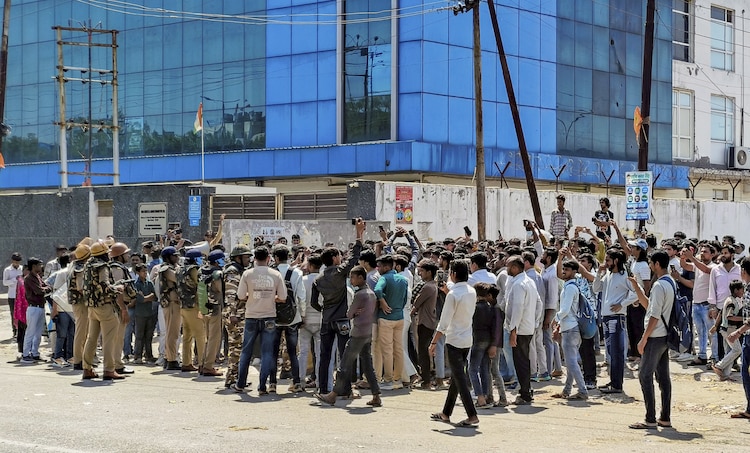
When workers remain outside the legal framework, when accountability is diffused through layers of contracting, and when violations are overlooked despite being in plain sight, tensions do not disappear. They accumulate.
What eventually surfaces is not just a labour dispute, but a breakdown of trust between workers, employers and the system meant to regulate them.
The question is no longer whether the law exists, but whether it is meant to be enforced.
(Views expressed in this opinion piece are those of the author)