
The Supreme Court on Monday said its recent order proposing a court-monitored committee to complete 30 pending Supertech housing projects was aimed at protecting homebuyers and agreed to consider next week the developer’s plea to recall the order and restrict court oversight to 16 projects being executed by NBCC.
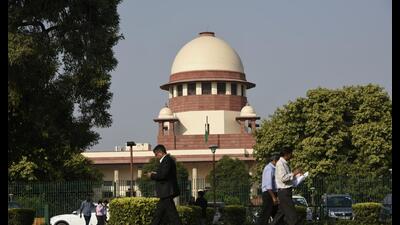
On April 10, the court proposed appointing an independent, court-monitored committee to ensure timely completion of all projects that were partially or substantially constructed before Supertech entered insolvency proceedings before the National Company Law Tribunal (NCLT).
The move followed the suspension of Supertech’s interim resolution professional (IRP), Hitesh Goel, by the Insolvency and Bankruptcy Board of India (IBBI) last month for two years over alleged lapses under the Insolvency and Bankruptcy Code (IBC).
A bench of Chief Justice of India Surya Kant and Justice Joymalya Bagchi said, “We only seek to bring parity among all homebuyers so that they do not feel left out. Suppose the IRP was there, this issue would not arise. But currently, the committees set up for the various projects are headless,” the bench said.
Appearing for Supertech, senior advocate Shyam Divan sought recall of the April 10 order, arguing that court intervention should be limited to 16 projects already handed over to NBCC. “The court can replace the IRP, to which we do not object. But the order should be restricted to 16 projects. It ought not to be expanded to 30, as the remaining 14 are pending before the NCLAT,” he said.
Divan also objected to the role of court-appointed amicus curiae Rajeev Jain, saying Supertech received his report only after the order was passed. “Propriety demanded that we be served a copy of the application along with accompanying documents,” he said.
The court, however, defended the amicus. “This was our idea. The amicus has no interest in the matter. We wanted to ensure no sense of insecurity is created among homebuyers,” the bench said, noting that the earlier arrangement had become untenable after the IRP’s functioning came under scrutiny.
Jain told the court that in its February 5 order, while approving the National Company Law Appellate Tribunal’s (NCLAT) December 2024 decision to hand over 16 projects to NBCC, the court had allowed him to approach it if any impediment arose. He said the IRP’s suspension had disrupted the implementation process, as the IRP headed both the apex committee and project-level committees constituted under NCLAT orders.
“If 16 projects are being handled by NBCC, what about the rest? Supertech has ongoing projects, litigations, loans and financial transactions. These interests also have to be protected,” Jain said.
Other creditors and homebuyers present during the hearing sought representation in the proposed committee. The bench directed the amicus and stakeholders to respond to Supertech’s plea and submit suggestions on the composition of the committee. “Once we constitute a committee, we will pass orders in open court,” it said.
The apex committee, formed by the NCLAT in December 2024, comprised the IRP and four members — two nominees of major financial creditors, one nominee of NBCC, and a real estate expert. Each project also had a five-member committee headed by the IRP, with representatives of creditors, the land authority, homebuyers and an industry expert.
The IBBI’s March 30 order suspending Goel, which came into effect on April 29, found him guilty of multiple lapses, including failure to disclose material information, delay in convening the Committee of Creditors, and delays in filing avoidance applications.
According to Supertech, the 16 projects under NBCC span Uttar Pradesh, Uttarakhand and Bengaluru, covering over 50,000 flats across Noida, Greater Noida and other locations.