
MUMBAI: In Mumbai, where ageing buildings standing on prime real estate are known to pass into the redevelopment maze, one structure built in 1972 has chosen a different path – that of reimagining its past instead of fading out.
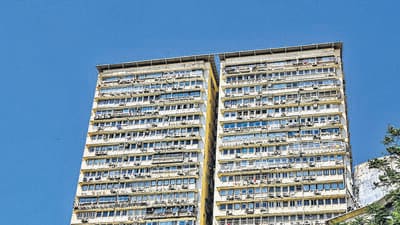
The Panchratna building, a landmark near Opera House, which was once the centre of India’s diamond trade, with around 90% of the country’s diamond deals passing through it, has now returned to its original avatar – evidenced by the line of clothes drying outside windows of apartments on the upper floors. This was possible as the diamond traders moved their businesses from here to the Bharat Diamond Bourse (BDB), in Bandra Kurla Complex (BKC), and Surat, Gujarat. 121 of its 144 flats, which once served as offices for leading diamond merchants, are now home to families.
While the inflow into the houses, which were converted into offices, began in 2011 when diamond traders started taking their businesses to BDB, it is only recently that the building reached full occupancy. Flat buyers at the time found economic merit in leasing out the spaces for commercial use, with many choosing to rent living spaces in the vicinity.
Today, real estate prices of residential and commercial spaces here range between ₹40,000 to ₹55,000 per square foot for spaces between 700 to 1200 square feet.
Chirag Patel, a businessman, who moved here eight years ago, said: “I moved to Panchratna as it offers the best view of the sea. After the building turned from commercial to residential I decided to grab the opportunity considering its closeness to most important neighbourhoods.”
Chandrika Nagraj, who has lived here since 37 years, is happy to be surrounded by several neighbours, as opposed to the time when it had become a commercial hub. “The building offers the best view of the sea. People prefer to move here, as schools, colleges, hospitals and even the railway station is close by. The building continues to have tight security even after the diamond market shifted to BKC,” said Nagraj.
Making of a commercial hub
The 25-storeyed Panchratna, built 54 years ago, was envisioned as a part-commercial, part-residential hub. The ground to six floors were designed for commerce, bearing in mind the growing diamond trade in the city, which was being conducted primarily from the crowded Dhanji Street, in Kalbadevi (around 3 kilometers from Opera House) at the time. Holding the seventh floor as the refuge area, 144 flats were constructed in the upper 18 floors. The building was designed in such a manner that the residential spaces faced the Arabian Sea, offering a grand view of the Queens Necklace, Malabar Hill and Nariman Point, while the commercial spaces overlooked the busy streets outside.
However, in around three years after its completion diamond trade boomed and a majority of residential apartments in Panchratna were converted into offices by diamond merchants and others associated with the trade, making it one of the costliest commercial spaces in Asia at the time.
In 2002, the Brihanmumbai Municipal Corporation (BMC) officially recognised the change, considering the demand for space and the status of the diamond hub, and the Standing Committee passed a resolution allowing Panchratna to convert its residential floors to commercial tenements.
“Each flat was changed into three commercial units in 2002, leaving only 10 residential flats. Today, however, commercial properties have again changed to residential and 121 families are occupying the flats on upper floors now,” said Naresh Mehta, secretary of Panchratna Co-operative Housing Society, adding that the commercial units are primarily occupied by jewellers such as Popley, advocates, doctors, chartered accountants and diamond grading and accreditation agencies.
By the early ’80s the 25-storey tower became the centre of Mumbai’s diamond trade, and within a short span, the market expanded into 10 adjoining buildings in the area, including Prasad Chambers, Modi Chambers and Parikh Chambers, housing around 4,500 stores. Traders from overseas, especially from Belgium and Israel, were often seen in the small stores along the cobbled street.
As almost all the vaults were housed in Panchratna, traders from the entire locality would return to the building in the evening for safekeeping of the precious stones. About 60% of the world’s diamond processing passed through the Opera House. According to estimates of trade veterans, at its peak the building generated an annual turnover of over ₹5,000 crore.
“During the glorious period, we installed 386 CCTV cameras for round-the-clock surveillance and posted 32 security guards in the building, as it recorded a footfall between 10,000 and 12,000 every day. Today, the number is less than half and the building now still sees around 4,000 visitors every day, especially to the offices in the first six floors,” said Mehta.
According to the ministry of commerce, in 2010-11, India imported 150 million carats of rough diamonds and exported 59.9 million of cut and polished diamonds valued at $18.24 billion, with around 90 percent of the deals concluding in the Opera House area – where the diamond traders, graders and dealers felt safe despite the locality remaining always crowded.
“The crowd provided anonymity to the dealers who moved the diamonds through the bylanes safely by mixing in the crowd, keeping the precious stones wrapped in tissue papers in their pockets,” said a dealer.
The euphoria, however, started fading after July 13, 2011, when at around 6.55pm of that day a powerful improvised explosive device went off in the lane between the Panchratna building and Prasad Chambers, killing and injuring several people. This was part of one of the three co-ordinated bomb blasts; the other two being at Zaveri Bazar (10 minutes before the Panchratna blast) and another near Kaburtarkhan in Dadar (10 minutes later). The three blasts in all took 27 lives and left 127 injured.
“Everything changed after the 13/7 bombing,” said Mehta. “After the bomb blasts, the diamond business started moving from the Opera House area to BDB, which was standing ready from October 2010.”
Spread over 20 million square feet and shaped like a diamond, the BDB has 2,500 offices and an ultra-modern security arrangement with armed guards, a feature which was absent in the Opera House area, where merchants had to ferry their diamonds every evening to the vaults at Panchratna for safekeeping. Besides, BDB provided a complete eco-system for the traders – apart from trading, there were opportunities for grading, banks and dealers.
Panchratna’s timeless charm
Rajan Parikh, vice president of Mumbai Diamond Merchants Association, said though merchants were nostalgic about the Opera House area, they found it necessary to move on with time – BDB was the destination considering the facilities it offered. “Availability of a large area, modern security arrangements, avenues for promoting individual businesses, banks and travel agents – everything is available under one roof,” said Parikh.
“Panchratna, however, still holds a special place in our mind – we fondly look back at the food on offer, the south Mumbai vibe and connectivity to the suburbs, given the proximity to Charni Road station. All of us made money and developed our businesses there,” Parikh said, adding that many diamond merchants have still retained small office spaces in Panchratna even after shifting their main business operations to BDB.
Mehta added: “The building was far ahead of its time – planned for the future. The commercial floors were centrally air-conditioned and had 12 modern lifts – six for the first six floors which face the lane and remaining six for the upper 18 residential floors.”
Kirit Bhansali, chairman of Gem and Jewellery Export Promotion Council (GJEPC), agreed. “The winner was the fact that as most of us stayed in south Mumbai, we would get freshly cooked lunches from our homes, while some elderly people would go home for lunch. Opera House area also offered some of the choicest food options,” said Bhansali, adding that after moving to BKC, “most of us miss the food outlets at Opera House”.
Another proud occupier of a commercial space is Popley & Sons Jewellers. “We own a commercial space in the building since 1978 and continue to function from there,” said Rajiv Popley, director, Popley Group of Jewellers. “The area is special despite the majority of the market having shifted to the bourse at BKC and Surat. We never thought of moving out of the building. Besides, the locality is well connected to other parts of the city,” he added.