
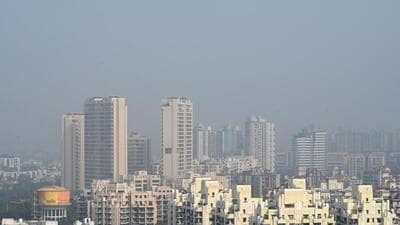
Even as high-rise towers continue to rise across Noida’s skyline, the city’s firefighting capacity appears to be tethered to a far lower height. With more than 1,500 high-rises exceeding eight floors and over 1,000 medium-rise buildings, the Gautam Budh Nagar Fire Department is operating with just four hydraulic platforms – the tallest of which can reach only 42 metres, or roughly 14 floors – exposing a gap in emergency preparedness.
The limitation came into focus on Wednesday when one of these 42-metre platforms had to be rushed to Ghaziabad to assist in dousing a high-rise blaze, underscoring the scarcity of such critical equipment.
Fire officials acknowledge the shortfall. “We have only four hydraulic platforms as of now. The highest reaches 42 metres and can access fires only up to around the 14th floor,” said GB Nagar chief fire officer Pradeep Chaubey. “A 72-metre platform was sanctioned earlier and is expected to arrive in one or two months.”
A senior fire department official said the existing platforms fall short of what is required to tackle emergencies in newer high-rises. “The taller of the four can access fires only up to the 14th floor. Beyond that, we depend heavily on the building’s internal firefighting systems,” the official said.
But for a city where residential towers routinely exceed 20 or even 30 floors, the gap is glaring. Resident welfare associations (RWAs) and urban planners point out that in the event of a fire above the reach of cranes, firefighting operations rely almost entirely on internal systems such as sprinklers and hydrants – systems that may not always function optimally under extreme conditions.
KK Jain, secretary general of Federation of Noida Residents Welfare Associations (FONRWA) said, “Considering the number of high-rises in Noida and Greater Noida, the fire department should be equipped with the longest hydraulic platforms. The district does not house one or two high-rises; it has more than a thousand.”
“Around a year back, we have written to the director general of police in Lucknow, demanding the tallest hydraulic lifts for Noida firefighters, but no action has been taken. People living above the 13th to 14th floors are at constant risk and left to the mercy of sprinkling systems within the towers, if they exist at all,” Jain said.
To bridge the gap, the department has proposed the procurement of more advanced hydraulic platforms with reach capacities of 72, 92 and even 104 metres. These machines would allow firefighters to directly access upper floors of buildings rising up to 30 storeys or more.
The urgency is compounded by the nature of Noida’s vertical expansion. Among the most prominent examples is the Supernova tower in Sector 94 – one of India’s tallest residential buildings – which rises to nearly 300 metres and has close to 80 floors.
Experts warn that as buildings grow taller, the risks multiply. Fires in high-rises tend to spread quickly through shafts, ducts and combustible materials, while evacuation becomes more difficult with increasing height. In such scenarios, the ability to reach upper floors externally can prove critical, particularly when internal systems fail or are overwhelmed.
Adding to the equipment shortfall is a severe manpower crunch. The Gautam Budh Nagar Fire Department currently operates with just 85 personnel against a sanctioned strength of around 350. This shortage strains response capacity, especially during large-scale incidents or when multiple emergencies occur simultaneously.
The department on April 24 conducted a demonstration of a Compressed Air Foam (CAF) system, which uses a mix of water, foam and air to extinguish fires more efficiently. The demonstration, led by director general of UP Fire and Emergency Services Sujeet Pandey, was held on the 45th floor of a high-rise in Sector 94. “The CAF system can help control fires quickly, especially in high-rise settings,” Pandey said, adding that efforts are under way to upgrade firefighting infrastructure in Gautam Budh Nagar.