
The Haryana government has amended the Haryana Building Code 2017 to empower authorities to conduct periodic inspections of rainwater harvesting (RWH) systems installed in individual houses, plotted colonies and condominiums, and recommend cancellation of occupancy certificates (OCs) if deficiencies are not rectified within the stipulated time.
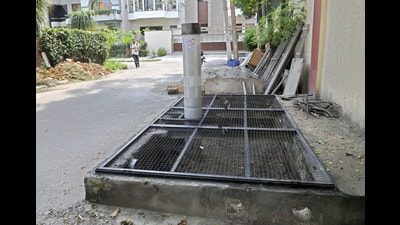
The amendment, issued by the department of town and country planning through a notice dated May 12, mandates property owners to submit self-certification on an online portal confirming that RWH systems are functioning properly. It also authorises the competent authority or any authorised person/body to inspect premises where RWH systems were installed as a condition for the grant of an occupancy certificate.
“The competent authority (including any authorised person/body) shall conduct periodic inspections of premises wherein rainwater harvesting systems stand installed based on which occupancy certificate was granted with prior notice to the concerned to ensure proper functionality, maintenance and upkeep of the rainwater harvesting systems,” the notice stated.
If deficiencies are detected during inspection, owners will be issued notices directing rectification within four weeks. Failure to comply could invite penal action, while continued non-compliance for eight weeks from the initial notice may result in revocation of the occupancy certificate on the recommendation of the inspection authority, officials said. No definite timeline has been provided for commencement of statewide inspections, with authorities only indicating that inspections will begin in the near future.
DTCP officials said the amendment assumes significance because authorities earlier lacked adequate legal and regulatory backing to penalise or act against non-functional RWH systems.
RS Bhath, district town planner, enforcement, GMDA, called the empowerment of inspection authorities an important step. “The authorised persons can now check the RWH structures and, in case deficiencies are found, take action as per the legal framework created by the amendment,” he said.
Bhath said GMDA had conducted workshops on RWH systems for 68 condominiums spread across more than 10 acres and that inspections in 15 condominiums found non-functional systems, following which societies were directed to restore them. “Now more such inspections will be made, as RWH is crucial to prevent waterlogging in the city,” he said.
A drainage report submitted by a GMDA consultant in the last week of July 2025 found that nearly 50% of residential societies and 85% of houses in the city had non-functional rainwater harvesting structures, with recharge wells and pits requiring restoration, proper storage capacity and desilting chambers.
Under HSVP rules, rainwater harvesting systems are mandatory in houses built on plots larger than 100 square yards, with installation verified before possession certificates are issued.