
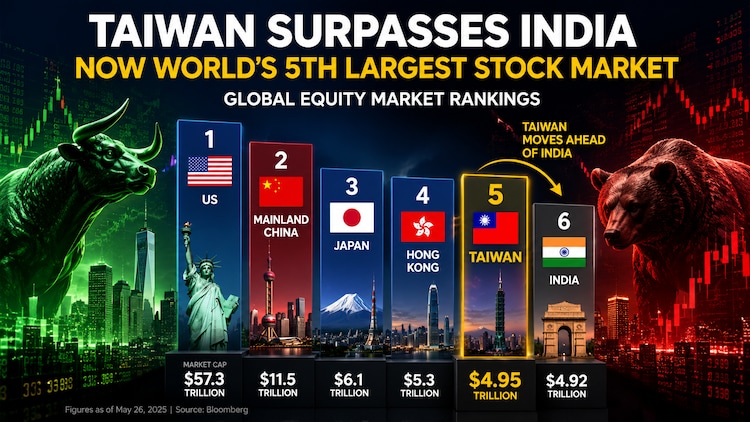
A country with a population smaller than Delhi has just overtaken India to become the world’s fifth-largest stock market.
Taiwan’s stock market value has climbed to $4.95 trillion, moving ahead of India’s $4.92 trillion market capitalisation, according to Bloomberg data. Taiwan now ranks behind only the US, mainland China, Japan and Hong Kong in global equity market rankings.
The development has surprised many because India has more listed companies, a far larger economy by scale, a population of over 140 crore people and one of the world’s fastest-growing retail investor bases.
Taiwan, by comparison, has a population of barely 2.3 crore.
Yet global investors are increasingly pouring money into Taiwan while pulling billions out of Indian equities.
The reason lies in one word: artificial intelligence.
Taiwan’s rise has been powered overwhelmingly by the spectacular rally in chip giant Taiwan Semiconductor Manufacturing Company or TSMC, the world’s largest semiconductor manufacturer and one of the biggest beneficiaries of the global AI boom.
TSMC alone now accounts for nearly 42% of Taiwan’s benchmark stock index, showing how heavily concentrated the market has become around one company.
Its shares have surged 49% this year as global demand for AI chips exploded.
The company manufactures advanced chips used by Nvidia, Apple, Advanced Micro Devices, and Qualcomm.
As artificial intelligence became the biggest global investment theme, investors rushed into semiconductor and AI-linked markets, disproportionately benefiting manufacturing hubs such as Taiwan and South Korea.
That flood of global capital sharply lifted Taiwan’s market value.
India, meanwhile, is battling a completely different economic environment.
The country is currently dealing with surging energy costs, slowing corporate earnings growth, sustained foreign investor selling, and the absence of listed companies directly linked to the global AI infrastructure boom.
Unlike Taiwan, India does not yet have globally dominant listed semiconductor or AI hardware companies attracting large international capital flows.
Kranthi Bathini, Director – Equity Strategy at WealthMills Securities, said the market shift reflects where global money is moving right now.
“One thing is always price. Stocks are slaves to earnings. In the medium to short term, there is earnings contraction in India and rising energy prices have created pressure on the economy,” he said.
“And there is an AI theme, technology theme and semiconductor theme which has played out in the recent year. India does not have substantially strong AI or semiconductor theme in listed entities,” Bathini added.
Another major reason behind Taiwan overtaking India has been persistent foreign investor outflows from Indian equities.
Foreign institutional investors (FIIs) have pulled out billions of dollars from Indian markets this year amid concerns around:
The outflows this year have already crossed last year’s record levels.
The Iran conflict and higher global energy prices have worsened concerns around India’s import bill and inflation outlook.
India imports nearly 90% of its crude oil requirements, making the economy highly vulnerable to oil price shocks.
At the same time, the rupee had weakened close to the 97-per-dollar mark recently before recovering slightly.
“The continued depreciating rupee also created some kind of skittishness for foreign portfolio investors,” Bathini said.
“Always the hot money chases growth. That is where the Indian market has underperformed in the medium to short-term perspective,” he added.
India has:
Taiwan has:
While India’s market is broad-based and consumption-driven, Taiwan’s market is heavily concentrated around export-led technology manufacturing.
And right now, global investors are aggressively rewarding AI and semiconductor-linked economies.
Analysts say Taiwan overtaking India does not necessarily mean India’s long-term market story is weakening.
India continues to receive strong domestic flows through SIPs and retail participation even during periods of foreign selling.
Domestic institutional investors have repeatedly helped stabilise Indian markets when FIIs pulled money out.
Bathini believes the current underperformance is linked more to global sector preferences and short-term macroeconomic pressures than a structural collapse in India’s market story.
Still, the development clearly highlights one important trend: global capital is currently chasing AI, semiconductors and technology manufacturing far more aggressively than traditional consumption-driven emerging markets.