
Maharashtra Chief Minister Devendra Fadnavis inaugurated the 13.3-km Mumbai–Pune Expressway ‘Missing Link’ project on May 1, coinciding with Maharashtra Day. The project, which connects Khopoli to Kusgaon near Lonavala, is expected to cut travel time between Mumbai and Pune by 20–30 minutes by bypassing the congested Khandala Ghat stretch, while making the expressway fully access-controlled.
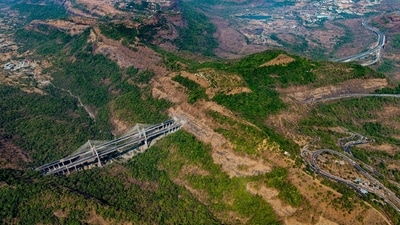
The improved connectivity is likely to boost real estate potential across emerging Mumbai 3.0 corridors such as Karjat, Neral and Lonavala, which are gaining traction as residential and second-home destinations, even as experts note that the warehousing and logistics sector stands to benefit significantly once the route is opened to heavy vehicles.
The project, implemented by the Maharashtra State Road Development Corporation (MSRDC), is now open to the public. The Mumbai-Pune Expressway is India’s first Expressway.
The ‘missing link’ starts near the Khalapur Food Plaza on the Mumbai Pune Expressway and, with the help of a cable-stayed bridge and tunnels, meets the Expressway between Lonavala and Talegaon.
It is currently operational only for light motor vehicles and buses; goods and heavy vehicles will be allowed, subject to a review after six months, the Maharashtra government said in a notification earlier this week.
The ‘Missing Link’ project is poised to be a game-changer for the extended Mumbai Metropolitan Region (MMR), significantly boosting real estate potential across the emerging corridors collectively known as Mumbai 3.0.
Experts say Karjat, Neral, Khopoli and Lonavala are well-positioned to benefit from the next wave of growth, particularly among second-home buyers and long-term investors. Lower entry prices than in Mumbai and Navi Mumbai, along with rising lifestyle aspirations, are further supporting demand in these micro-markets.
Also Read:
Gautam Thacker, founder, president and chairman, NAREDCO Raigad, said, “Infrastructure projects like the Missing Link are critical in unlocking the potential of regions like Neral and Karjat. It effectively brings Pune closer to the Neral-Karjat belt and the larger Mumbai 3.0 region. This improved connectivity is already driving interest from Pune-based developers and homebuyers, who now see the region as more accessible and attractive.”
Also Read:
He added that seamless travel between key cities could accelerate real estate activity and create opportunities for planned development, helping the region evolve into a balanced urban extension of Mumbai, provided there is adequate policy support.
How does it impact the real estate market?
The warehousing and logistics sector is poised to benefit significantly once the ‘missing link’ opens to heavy vehicles, said experts.
“The inauguration of the Pune Missing Link marks a significant upgrade to one of India’s busiest transport corridors. This bypass on the Mumbai–Pune Expressway addresses a long-standing bottleneck, reducing travel time by nearly 30 minutes while diverting traffic from the vulnerable Ghat section, improving both safety and efficiency. The project’s scale is underscored by the inclusion of India’s longest and tallest road cable-stayed bridge across Tiger Valley,” said Gulam Zia, International Partner, Senior Executive Director, Research, Advisory, Infrastructure and Valuation, Knight Frank India.
“From a real estate perspective, such infrastructure is a key catalyst for market evolution. Improved connectivity between Mumbai and Pune is expected to strengthen integration between the two cities, unlocking new opportunities for residential and commercial development along the corridor,” Zia said.
“The warehousing and logistics sector is poised to benefit significantly. Faster, more reliable transit and the removal of a challenging terrain stretch will enhance turnaround times and operational efficiency. This is likely to drive demand for Grade A warehousing and foster the development of larger logistics hubs, supporting sectors like e-commerce, manufacturing, and third-party logistics,” Zia said.
Also Read:
Does the opening of the ‘Missing Link’ of the Mumbai-Pune Expressway impact the residential sector?
However, some experts say that the time savings from the ‘Missing link’ are unlikely to significantly impact property markets.
“The missing link may help save 15–30 minutes on the Pune–Mumbai commute, especially as the expressway currently faces heavy traffic and frequent accidents. However, from a real estate perspective, such marginal time savings are unlikely to make a meaningful difference to either city,” said Rahul Ajmera, developer at Vasupujya Corporation in Pune.
He added that the proposed could be a far more significant game-changer. “It could enable people to work in Mumbai while living in Pune, which offers better weather and relatively lower property prices. , daily travel by bullet train could prove more economical than paying high EMIs in Mumbai,” he said.
Also Read:
According to local brokers, the average apartment price in Pune ranges between ₹10,000 and ₹15,000 per sq ft, while in Mumbai it is significantly higher at ₹40,000 to ₹50,000 per sq ft. However, peak benchmark prices in premium micro-markets are considerably higher than these averages.