
Crystal Crop’s marigold R&D efforts has global firms coming to India to export the flower
Crystal Crop’s Indian marigold R&D attracts global buyers and outlines cheaper local orchid hybrids and future seed production plans.
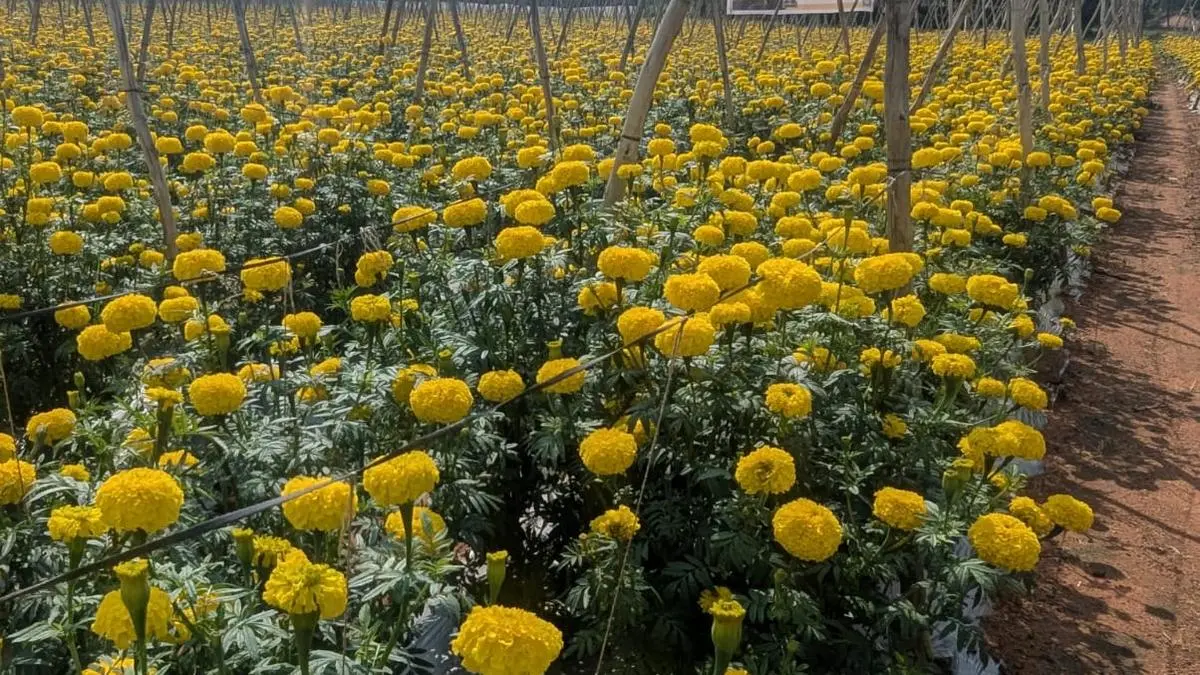
One of India’s first research and development (R&D) efforts to develop a hybrid marigold variety has led global companies to come to India and export the flower. The R&D effort came from Crystal Crop Protection Ltd (CCPL) a few years ago, and the hybrid’s seed has become the company’s number 1 revenue earner in seeds.
“There is a good demand for the marigold seeds of our Vijeyta hybrid due to 2-3 reasons. It has begun to replace chrysanthemum in some places as it has a longer shelf life. This looks like a tennis ball and can be kept in cold storage for 20-25 days. Increasing religious activities too have resulted in this hybrid becoming popular,” said Anurag Bajpai, Business Head, Vegetable and Flower Seeds, CCPL.
Crystal Crop was the first to begin breeding marigold hybrids and is the leading company in R&D of the plant. “We began the research in 2012 and cracked it in 2014,” said Ramamohan G, R&D Lead, Vegetable and Flowers Division, CCPL.
Flower’s feature
The feature of this marigold is that it has a tennis ball shape and can return to its shape even when it is squeezed hard. “This actually helps in transporting the flower to far-off places without worrying about damage,” he said.
CCPL’s Vijeyta marigold hybrid
Bajpai said the Vijeyta hybrid acceptance by growers saw foreign firms coming to India to breed the flower for production and exports.
With religious functions and marriages coming up every second month, farmers position their marigold crop to earn more. “Prices generally will tend to rise to ₹60 and even ₹100 a kg sometimes during Diwali. Farmers usually get ₹50-60,” said Purshothama MG - Biotech Lead - Vegetable & Flowers Division, CCPL. The new hybrid has been developed via the doubled haploid system, using the pollen.
Festivals get better returns
CCPL developed the marigold, orange in colour, after deploying markers from pure lines in 2012. Earlier, such marigold was being imported from Thailand.
Anurag Bajpai, Business Head, Vegetable and Flower Seeds, CCPL
KN Chandrasekharan, a farmer at Kajikalhalli village near Kolar in Karnataka, said he was growing the Vijeyta variety as its yield was good. “In festival times, our income goes up to ₹80 a kg. Earlier, I was growing Chrysanthemum, which is a lighter flower. Marigold is heavy and gives good returns,” he said.
Bajpai said CCPL will launch another marigold hybrid, which will be yellow in colour, next year.
Ramamohan said the marigold hybrid had strong stems and there won’t be lodging of the plant, which grows above 4 ft.
Different uses
Another farmer in a nearby village, Pillay Gowda, said he grows marigold for its size, shape and yield, which goes up to 10 tonnes.
Ramamohan G, R&D Lead, Vegetable and Flowers Division, CCPL
Bajpai said the flower has different uses in different parts of the country. While the whole flower is used for religious purposes up North, its petals are taken to make garlands in the South, particularly Tamil Nadu, he said.
Purshothama said Crystal Crop is developing hybrids of orchids, too, another first in the country.
Cheaper orchids option
“Developing a local hybrid means people here will get it cheaper than imported ones. India imports nearly ₹30 crore worth of orchids annually. The local orchids cost less than ₹400 for one,” he said.
Purshothama MG - Biotech Lead - Vegetable & Flowers Division, CCPL
Ramamohan said Thailand exports a lot of orchids and releases new hybrids every year. “We have developed orchids through tissue culture using local germplasm. They are 100 per cent Indian hybrids,” he said.
Bajpai said CCPL planned to tap the first mover advantage in orchids and has a lot of varieties in the pipeline.
Purshothama said after developing seeds, Crystal gives them to independent breeders to develop the plants and, in turn, sell them to customers.
Bajpai said CCPL plans to go in for production of seeds of orchids, jasmine and roses in the future. “This will help increase the number of growers cultivating these horticulture plants,” he said.
(The writer was at CCPL’s vegetable and seed R&D Centre in Bengaluru recently at the invitation of the company.)
Source: BusinessLine Economy
Disclaimer: This article is for general information and does not constitute investment, tax or legal advice. Markets and rates change; please verify with official sources or a qualified professional before you act.