
Reliance Industries’ real estate arm, Reliance 4IR Realty Development, as part of a consortium, has secured the redevelopment rights for the 101-acre Juhu Lane–Gilbert Hill slum cluster in Mumbai’s Andheri, marking the conglomerate’s entry into the city’s slum redevelopment sector.
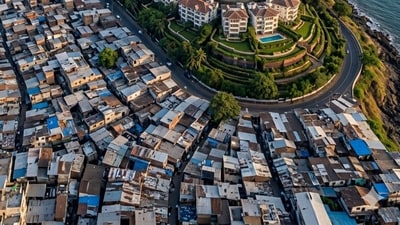
The project is among Mumbai’s largest redevelopment opportunities and is strategically located in the western suburbs. Here’s a look at the project’s location, scale, key stakeholders, and what the redevelopment could mean for residents, developers and Mumbai’s housing market.
All about Juhu Lane- Gilbert Hill slum cluster
The Juhu Lane to Gilbert Hill Slum Cluster covers 101.36 acres in Mumbai’s Andheri West area, making it one of the largest and first projects to move forward under the Maharashtra government’s newly introduced slum cluster redevelopment policy.
The project, tendered by the Slum Rehabilitation Authority (SRA), is expected to rehabilitate more than 28,000 homes for eligible slum dwellers, according to a Hindustan Times report.
According to the report, the land parcel stretches from Juhu Lane (CD Barfiwala Road) to JP Road near the Hansraj Morarji Public School. The site currently has 13,634 slum tenements, some SRA buildings, a private hospital, a police station, a civic market, a retail market, educational institutions, and government offices.
Also Read:
Gilbert Hill: The ancient rock formation at the heart of Mumbai’s latest redevelopment project
Gilbert Hill is a rare 200-foot-high monolithic basalt rock formation in Mumbai’s Andheri area, believed to be around 66 million years old. Formed from lava flows associated with the ancient Deccan Traps volcanic activity, it is considered one of the few surviving basalt monoliths of its kind in the world.
The area surrounding the hill comprises several slum settlements and ageing structures that are proposed for redevelopment under Mumbai’s slum rehabilitation programme. Beyond its geological significance, Gilbert Hill occupies a strategically important location in Mumbai’s western suburbs, with proximity to major commercial hubs, metro connectivity and established residential neighbourhoods, making it a notable landmark from both heritage and real estate perspectives.
Who will construct the project?
The over 100-acre slum redevelopment cluster will be constructed by the Reliance-led consortium, which includes Mahadev Realtors Juhu Private Limited, a subsidiary of Aspect Realty.
The consortium successfully outbid JSW Realty and Infrastructure Pvt Ltd and Shapoorji Pallonji Real Estate Pvt Ltd to secure the contract. Bidders were evaluated on the premium they offered over the SRA’s ready reckoner land rate, with the minimum bid threshold set at 10%.
The report said the Reliance-led consortium will be required to commit approximately ₹700 crore towards transit rent for two years. It must deposit one additional year’s transit rent in post-dated cheques with the SRA, ensuring uninterrupted rental support to eligible residents during the rehabilitation and construction period. The successful bidder is also required to submit a performance guarantee of ₹100 crore to the SRA.
According to a report published in the Hindustan Times newspaper, redevelopment of the prime land will be undertaken under the construction-and-development agreement model, wherein existing inhabitants will be rehabilitated on-site, the state government will receive a share of the housing stock, and the developer will be allowed to sell the remaining stock in the open market.
The appointed developer will have to construct 561 tenements measuring 300 sq ft each for existing residents. The developer must deposit ₹1,050 crore with the SRA towards transit rent for three years, at ₹20,000 per month per tenement, whereas eligible slum residents will have to pay a one-time shifting charge of ₹15,000.
The timeline for delivering the entire rehabilitation component has been set at 9.5 years (114 months) from the issuance of the first Commencement Certificate. Upon receipt of the first Commencement Certificate, at least 25% of the approved buildings must be ready and handed over to the families.
Also Read:
What is the slum rehabilitation scheme?
The in Mumbai is a government-led scheme that redevelops slum areas by providing free, legal housing to eligible slum dwellers. In exchange, developers gain the right to utilise the freed-up land for saleable projects, thereby balancing social welfare with real estate development incentives.
Under the SRA scheme, rehabilitated slum dwellers get a 1 BHK apartment of around 330 sq ft. During construction of rehabilitation apartments, slums are demolished, and displaced slum dwellers are provided with interim rent.
The above project is among the largest announced after the Maharashtra government tweaked its policy in 2025.
In a major policy shift in November 2025, the Maharashtra government’s GR explicitly states that the consent of slum dwellers is not required for implementing the Slum Cluster Redevelopment Scheme. This represents a significant departure from the existing SRA framework, which requires the consent of the majority of slum dwellers for standard redevelopment under the SRA scheme.
According to the GR, cluster projects encompass large, contiguous areas of 50 acres or more, often combining slums with old buildings, dilapidated chawls, industrial units, and government land. According to Maharashtra government officials, removing the consent requirement would enable faster execution in unsafe, highly congested zones where redevelopment has been stalled for decades. However, for all non-cluster projects, typically individual slum pockets or plots of less than 50 acres, the existing requirement for the consent of the majority of slum dwellers will be required.
Also Read:
What is cluster redevelopment?
approach in which multiple adjoining buildings or plots are combined into a single large project. It allows better planning, improved infrastructure, wider roads, open spaces, and amenities, while enabling the rehabilitation of existing residents and the more efficient use of land in crowded cities.
Examples of cluster redevelopment in the Mumbai real estate market include MHADA layouts such as Motilal Nagar (Goregaon), Abhyudaya Nagar (Parel), Adarsh Nagar (Worli), Bandra Reclamation, and GTB Nagar (Sion), as well as Kamathipura. Several private housing societies also undergo cluster redevelopment. The largest example of cluster redevelopment is the Dharavi Redevelopment project, which has been granted special project status by the Maharashtra government.