
In the late 90s every other weekend I would go to meet my grandmother in Vasant Kunj, the weekend was fueled with cable television and Cartoon Network, the biggest gift of liberalisation for us kids those days. She lived in B-10 across from GD Goenka School and a community centre. The market was famous: it had an Archie Comics shop; a bookstore; and also a Nirula’s, a Delhi chain, much like Pop’s diner in the comics with its ice cream, pizza, burgers, and floats.
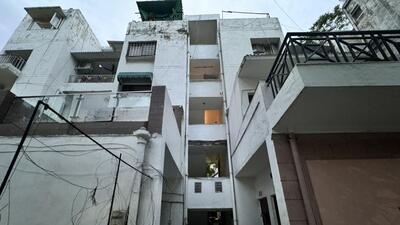
The DDA flats at Vasant Kunj were shiny, new, and full of amenities that completely pushed boredom out of childhood. No matter which DDA in the city you lived in, some things were common: the wide concrete railing for the stairs, the open staircase looking over the park with a road on either side, big water tanks installed on the ground floor; and window grills for security.
Envisioned over 69 years ago and actually debated in parliament philosophically, the DDA vision was idyllic. Even today, most people who live in DDA apartments maintain the same structure with little renovation.
On 20 December 1957, during the Lok Sabha deliberations on the Delhi Development Bill, veteran parliamentarian Bhupesh Gupta reportedly remarked, “We are creating not merely a housing authority, but a civic conscience for a new Delhi,” emphasising that the DDA was being envisioned as an instrument of both social justice and national identity. This anecdote has since become part of Delhi’s planning lore.
The establishment of the Delhi Development Authority in 1957 marked a significant turning point in India’s urban planning trajectory. Tasked with rationalising growth in the rapidly expanding capital after Partition, the DDA embodied the Nehruvian ideal of state-directed modernisation. The groundwork for such an authority had been laid earlier, through the Delhi Improvement Trust (1937- 57) and the 1950 committee chaired by S. G. D. Birla, which recommended a unified planning body. While Birla was not an architect, his role as the first chair of the committee for DDA’s inception underscores the political and industrial foundations of Delhi’s urban planning.
The first official DDA housing scheme — Bhim Nagri in Hauz Khas (1969-71) — exemplified early state modernism. Comprising seventy-four flats in eight buildings, interspersed with three parks, the colony sought to integrate privacy of apartment living with community through common greens.
The architectural typology standardised prefabricated structures with modest unit sizes reflecting international modernist influences adapted to Indian conditions. Yet its significance extended beyond design: residents recall cohesive community practices, including collective festivals, and sporting activities, revealing how planned housing restructured sociality. The colony thus created new urban domesticities in line with postcolonial aspirations for dignified, modern living.
With India’s economic liberalisation in the 1990s, Delhi experienced an influx of private sector jobs and new middle-class professions. DDA colonies such as Vasant Kunj, Mayur Vihar, and Rohini responded to these shifts by offering flats, cooperative group housing, and plotted developments targeted at upwardly mobile nuclear families.
These colonies exemplified the negotiation between privacy and community. Nuclear family apartments were embedded within pockets of parks and markets, facilitating both domestic autonomy and neighbourly sociability. Festivals, neighbourhood clubs, and informal economies flourished within these spaces, reinforcing communal belonging.
The housing typologies enabled professional couples to sustain dual-income households with access to schools, transport, and leisure spaces. Housing lotteries became cultural rituals of middle-class aspiration. Securing a DDA flat marked entry into urban respectability.
DDA housing also transformed Indian domesticity by promoting nuclear family apartments over joint family houses, while still embedding collective green and recreational spaces.
Here, DDA housing must be situated within the understanding that it has a harnessing power; the “production of locality” wherein the authority’s planned environments were not only physical but cultural constructs, shaping how families imagined themselves as participants in a modern, globalising Delhi.
Conceived in the late 1980s as one of three “mega sub-cities” alongside Rohini and Dwarka, Narela was designed for over 1.6 million residents. Its ambition was to integrate affordable housing with industrial and commercial nodes. Yet poor connectivity, lack of infrastructure, and small unit sizes rendered it unattractive. By the mid-2010s, thousands of flats remained unoccupied or returned. Concerted action to this day by the state is made to reclaim the investment, even to the extent of rebranding the sub-city’s name to give it a ‘happier’ name Vindhyachal Sub-City.
Securing a DDA flat through lottery represented class mobility and “symbolic capital”. It signified both economic advancement and cultural legitimacy in Delhi’s middle-class milieu.
DDA colonies blurred the boundary between private dwelling and public life. Parks, markets, and streets became sites of interaction, negotiation, and surveillance. Early colonies like Bhim Nagri embodied a vision of participatory urbanism, whereas Narela’s under-occupied complexes illustrate the collapse of this balance.
DDA housing has profoundly shaped Delhi’s architectural and cultural life. Its early colonies realised the promise of the modernist community, its liberalisation-era enclaves embodied nuclear family aspirations, and their sub-cities demonstrated both ambition and precarity.
In many ways the DDA flats of Delhi subsume important markers such as the evolution of the Indian family, the economics of cities, the urban culture of community based living and popular culture in the 90 by the way the community centres and public spaces within the enclave invited pharmacies, restaurants, bookshops, butchers, barbers, and the good ole kirana shop.