
It is a common perception that men take the majority of loans in India. After all, they have traditionally been seen as the primary earners and financial decision-makers in many households. But scratch beneath the surface, and an interesting trend begins to emerge: lenders are increasingly warming up to women borrowers.
The reason? It is not simply about inclusion or diversity targets. It is increasingly about repayment behaviour.
Data from lenders suggests women are often more disciplined borrowers, miss fewer EMIs, prepay loans more actively and tend to borrow with a purpose. In short, many banks and fintech lenders believe women borrowers may come with lower repayment risk.
So, are women actually better at managing debt or is the story more complicated?
When I started looking into this, one thing stood out almost immediately: repayment patterns.
According to data shared by Adhil Shetty, CEO of BankBazaar, women seem to perform slightly better than men across several financial markers.
“Our data indicates women display relatively stronger repayment behaviour across several financial markers,” says Shetty.
He points to BankBazaar’s Attainment Index — which measures progress towards financial goals — where women scored 84.3, compared to 82.1 for men.
The difference becomes even sharper when repayment habits are examined.
“Around 10.98% of women reported missing a loan payment compared to 14.29% of men. Cases of repeated missed payments were also lower among women, at 3.25% versus 7.14% for men,” Shetty says.
Women also appear slightly more proactive about financial monitoring, with 90% tracking their credit scores, compared to 88% of men.
For lenders, even small differences in repayment discipline matter.
Because in lending, predictability is everything.
So what explains this trend?
One possible answer lies in why women borrow.
Shetty says women often approach debt more cautiously and for clearly defined purposes.
“Women’s lower default rates stem from cautious, purpose-driven borrowing,” he explains.
According to BankBazaar data, 29.27% of women borrow mainly for emergencies, compared to 25.43% of men, who are relatively more likely to use credit for discretionary spending.
The idea is simple: when borrowing is tied to essential goals, i.e., education, healthcare, family security or emergencies, repayment tends to become a priority.
Shetty says women also score higher on family-linked financial priorities, particularly relationship and wealth goals.
And perhaps that changes how debt is managed.
According to Rupee112, women borrowers often display strong repayment discipline, cautious borrowing habits and higher financial planning.
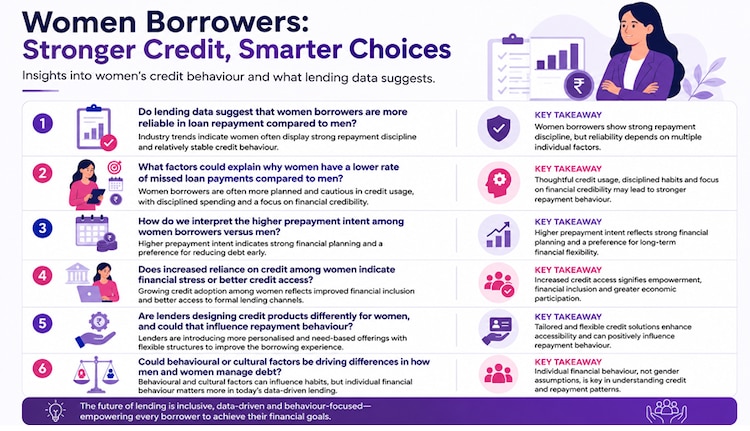
One of the clearest takeaways is this: women may not necessarily borrow more recklessly despite rising credit usage. Instead, growing participation in formal credit markets may reflect better financial inclusion and greater economic independence.
Rupee112 also highlights another interesting pattern, i.e, women show higher intent to repay loans, suggesting a stronger preference to reduce debt early and maintain financial flexibility.
Equally important, it reminds us that repayment behaviour is not only about gender. Individual financial habits, income stability and borrowing intent still matter.
Another surprising trend is prepayment behaviour.
Women appear slightly more inclined to clear debt before schedule.
BankBazaar data shows 18.29% of women intend to repay loans, compared to 17.43% of men.
Shetty believes this reflects a deeper desire for financial independence.
“For women, debt clearance is a crucial stepping stone to achieve broader financial ambitions,” he says.
Instead of carrying long-term liabilities, many women prefer reducing interest burdens earlier.
Even small prepayments, made consistently, can reduce total borrowing costs significantly over time.
It is not just one company seeing this trend.
Kaushik Chatterjee, Founder and CEO of lendingplate, says their own lending data also shows women often demonstrate stronger repayment seriousness.
“Our experience over the last four years, based on lending data across millions of loan accounts, consistently indicates that women borrowers demonstrate a higher degree of seriousness and commitment toward their financial obligations,” he says.
However, he adds an important caveat.
“Repayment behaviour is not a function of gender alone. It is shaped by multiple factors such as income stability, credit history, repayment intent, and overall financial discipline.”
In other words, women may show stronger trends on average, but good repayment still comes down to individual behaviour.
Lenders are also changing how they design loans.
Instead of standardised products, many are moving towards smaller, need-based borrowing, flexible repayment structures and personalised credit solutions.
Kuldeep Yudhuvanshi, Business Head at Rupee112, says tailored products may also be helping repayment outcomes.
“Flexible repayment structures and tailored financial products can improve accessibility and create a better borrowing experience, which may positively influence repayment behaviour,” he says.
Chatterjee says lenders are increasingly relying on data-backed underwriting rather than assumptions.
“At lendingplate, we respond positively to such data-led trends and extend higher eligibility considerations to women borrowers, where supported by underwriting insights,” he says.
To an extent, yes, but preference does not replace due diligence.
Lenders still assess income, credit history and repayment capacity carefully. Nobody gets a loan simply because of gender.
But when data repeatedly shows stronger repayment patterns, lower default rates and greater repayment discipline, it naturally shapes lending preferences.
Perhaps the bigger story here is not whether women are “better” borrowers.
It is that women are becoming more visible, confident and active participants in India’s credit economy, and lenders are paying attention.