
When 35-year-old Nimesh Shah (name changed) purchased a 3BHK apartment in a premium housing society in Mumbai’s suburbs, he believed he had finally secured an aspirational address in the city’s increasingly expensive real estate market.
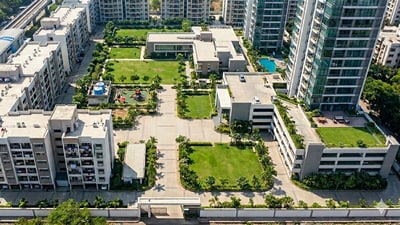
Earning nearly ₹6 lakh a month, Shah stretched his finances to buy a flat in a luxury residential tower that also housed larger 4 and 5BHK apartments. But shortly after possession, he realised that affording the apartment was only one part of the equation; sustaining the lifestyle expectations of the society was another challenge altogether.
The turning point came when residents in the building proposed redesigning the lobby interiors because they were unhappy with the existing aesthetics. Homeowners were asked to contribute from their pockets toward the upgrade.
For Shah, who was already paying an EMI of nearly ₹2.75 lakh every month and spending another ₹2 lakh to ₹2.5 lakh on household and lifestyle expenses, the demand became a financial strain. “I suddenly felt trapped, and even a single unexpected society expense started feeling stressful because most of my income was already committed,” he said.
Shah’s experience highlights a growing concern emerging in luxury township projects and premium gated communities across Mumbai, Pune, and Bengaluru: the financial mismatch between residents living in the smallest apartments and those owning significantly larger homes in the same complex. While developers in township projects may offer a mix of 2, 3, 4, and 5BHK configurations to cater to a wider homebuyer segment, the social and financial dynamics within such communities can sometimes pressure buyers at the lower end of the project’s pricing spectrum.
Also Read:
Real estate consultants say that in many luxury societies, discretionary spending on aesthetics, amenities, events and upgrades is often driven by residents of larger apartments with far higher disposable incomes. For homebuyers who stretched their finances merely to enter a premium address, these recurring costs can gradually become difficult to absorb, despite having relatively high salaries on paper.
Why is the discussion around mixed apartment sizes in housing societies gaining attention now?
The debate recently resurfaced online after a viral Reddit post from a housing society in Karnataka alleged that residents of 1 BHK and 1 RK apartments were barred from using amenities such as the gym and swimming pool despite paying maintenance charges. The post triggered widespread discussion around class divisions, unequal access to amenities and friction between residents of smaller and larger homes.
A resident wrote that the society had introduced rules preventing occupants of smaller apartments from using common facilities, even though maintenance was collected from all residents.
“In projects with varied apartment sizes, residents often contribute different maintenance amounts and possess different spending capacities. Over time, this can create divisions within societies, especially when decisions related to clubhouse usage, parking allocation or sinking funds arise,” said Dipesh Joshi, a Mumbai-based real estate consultant.
Also Read:
“In Nimesh Shah’s case, he was residing in South Mumbai, sold his smaller apartment and purchased a bigger one in a semi-luxury township in the suburbs. However, one year into the new house, he realised it was not sustainable in the long term. The reason was that residents of had different opinions from those in 3-BHK apartments, leading to clashes over day-to-day upkeep and financing. Ultimately, when Shah came to me, I suggested he sell the apartment and purchase it in a nearby project. However, downgrading is not an easy decision either,” Joshi said.
What do developers have to say about the product mix?
According to real estate developers, the product mix is more varied in township projects in cities like Pune and. “We have township projects in Pune and Bengaluru where developers are offering 1, 2, 3, and 4 BHK apartments in different buildings of the township. However, in Mumbai, there is hardly such a product mix,” a developer not wishing to be named said.
“We either have projects offering 1 and 2 BHK or 2, 3 BHK, or 3, 4, 5 BHK. This is the product mix, and it is also a safe mix to make projects viable. One reason for not having too many product mixes in Mumbai is also the shortage of land. Hence, developers have a very sharp and targeted product mix to ensure they do not go wrong,” the developer said.
Another prominent developer said, “In Mumbai, development control regulations generally do not restrict a residential project’s apartment mix, allowing developers to offer 1–5 BHKs in one society.”
Also Read:
The developer said, “However, restrictions mainly arise in special schemes like MHADA, SRA, or redevelopment projects with rehab or affordable housing obligations. In practice, product mix is driven more by economics, FSI efficiency, parking norms, and market demand.”