
India is among the top 10 markets for Nestle globally and has emerged as its highest-performing market in the first half of 2026.
“Emerging markets are driving growth for Nestle across the board and India is leading the pack,” Nestle global CEO Philipp Navratil said during his first visit to the country.
Navratil said the company was “very proud” of the performance, while pointing to further growth opportunities in the country.
While India is proving to be one of Nestle’s strongest markets, questions remain about why Indian consumers are being offered products that are nutritionally not at par with those sold in other major markets.
In India, consumer groups and independent studies have repeatedly raised concerns that big food brands such as Cadbury, Coca-Cola, PepsiCo, Nestle, etc offer products that are nutritionally inferior.
A 2024 report by the Access to Nutrition Initiative (ATNI), which assessed the world’s largest food and beverage manufacturers, found that only 30% of came from products that met the report’s definition of “healthy,” based on the Health Star Rating system.
The remaining 70% of Nestle’s sales were from products that did not meet that threshold.
The evidence from public-health guidelines, nutrition studies and independent product testing suggests that consumers have legitimate reasons to question whether some Nestle products sold in India are nutritionally inferior to comparable products elsewhere.
A report by news agency Reuters found that multinational food companies often sell different versions of the same products in different countries. It cited differences in local regulations, tastes and consumers’ spending capacity.
“Pricing and affordability are one of the biggest reasons recipes differ so much across countries,” said former Mondelez executive Parul Sharma to Reuters.
For example, the standard KitKat sold in India contains 4.5% cocoa solids, compared with at least 22% cocoa in the milk chocolate used in the Australian version.
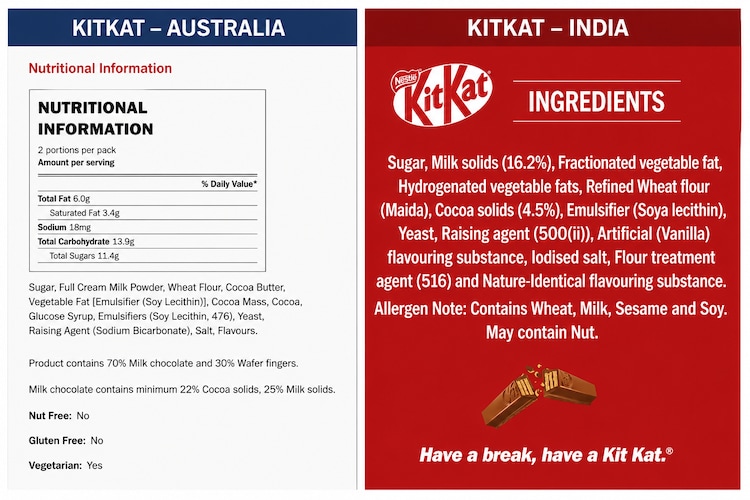
KitKat is only one such instance. The report also found differences in products such as Maggi and Cerelac across markets.
Its instant noodles, Maggi, use palm oil for the versions sold in India, whereas the other versions of the same product sold in Britain opt for sunflower oil. Some Maggi packets sold in Britain are also made in India, but they about their high salt content.
Nestle began selling a in India in 2024 after criticism over the presence of added sugar in its baby food.
This became important as the company had already sold sugar-free Cerelac in other markets, only adding India to the queue after the backlash from activists.
“It is the frustration of feeling cheated,” Revant Himatsingka, former McKinsey management consultant told Reuters.
None of this by itself means that Nestle’s Indian products are unsafe or fail to meet Indian regulations. But the differences raise a business question for a company that is increasingly relying on India for growth.
In fact, Nestle is not alone in facing scrutiny over differences in nutritional content and product labelling across markets. Several other widely consumed brands have also faced questions over how their products vary from one country to another, including Cadbury’s Bournvita, Coca-Cola’s Fanta, andLay’s and Kurkure.
In the June quarter of 2026, the company’s net profit jumped 48% to Rs 975 crore, where its revenue rose 25% to Rs 6,378 crore. All four of its major product groups, namely its prepared dishes, milk products, chocolates and beverages, recorded double-digit growth for the quarter.
This momentum has changed India’s position within Nestle’s global business.
India is now the world’s largest market for KitKat and Maggi, overtaking profiting markets such as Japan and Brazil.
In fact, Nestle has significantly expanded its reach beyond the metro cities. It has increased its distribution and put more money behind advertising and digital channels. As a result, the rural reach for the company has tripled since 2019 to around 2,16,000 villages, reported news agency Reuters.
Furthermore, the company is benefiting from the growing use of quick-commerce platforms and stronger demand for premium products.