
The upcoming Namma Metro Blue Line is expected to be a game-changer for Bengaluru, strengthening connectivity between key residential and employment hubs while linking the city’s south-eastern corridors to the airport in the north. As infrastructure along the Outer Ring Road improves, real estate experts say major employment clusters like Silk Board, HSR Layout, and Bellandur will see improved mobility and higher property prices.
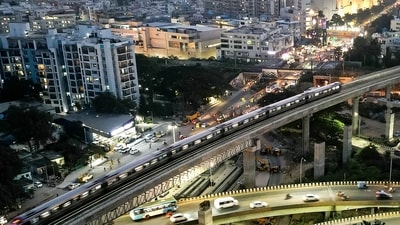
Planned along the high-density Outer Ring Road (ORR), the corridor is expected to improve accessibility across key IT and residential hubs, a factor that real estate experts say could drive both residential demand and commercial activity along the stretch.
Experts say that apartments are likely to see the highest traction along the Blue Line corridor, especially in the mid-income and premium segments that cater to the large professional workforce in these catchments.
Phase-wise rollout to unlock key micro-markets
The Blue Line is being implemented in two stages to accelerate execution. The first segment, from the Central Silk Board to KR Puram, is slated for completion by the end of 2026, according to Bangalore Metro Rail Corporation Limited officials. Spanning roughly 17.75 km across 13 stations, this phase will connect major employment clusters such as Silk Board, HSR Layout, Bellandur, ISRO, and Marathahalli.
Also Read:
The subsequent stretch from KR Puram to the airport is expected to be operational in the next few years, completing the full corridor and extending metro access into north Bengaluru.
Metro connectivity will boost mobility in already developed areas along the new line
Real estate experts say that the upcoming Namma Metro Blue Line is set to act as a strong growth driver for real estate across micro-markets such as Silk Board,
“These locations already benefit from proximity to major employment hubs, and enhanced metro connectivity will significantly improve commute efficiency and accessibility. This infrastructure upgrade is likely to support steady property price appreciation over the medium to long term and strengthen rental demand, particularly among working professionals. Improved connectivity typically enhances the overall livability of such corridors, making them increasingly attractive for both end-users and investors,” Sopan Gupta, co-founder and principal partner, Square Yards, told Hindustan Times Real Estate.
Also Read:
This comes at a time when the IT corridors along the line are already seeing major absorption of office spaces. Silk Board to Hebbal corridor along the Outer Ring Road represents a concentration of Bengaluru’s office landscape, housing approximately 95 million sq ft of Grade A office space, i.e., roughly 42% of the city’s total inventory. An additional 30 million sq. ft. of office development is pipeline-ready for completion by 2029, data from JLL India showed.
The real estate impact
Real estate experts say the upcoming metro connectivity along the Silk Board–KR Puram stretch in Bengaluru is expected to push property values, particularly in areas within close distance of stations.
“The major impact will be felt at the Silk Board intersection, which will see substantial transformation once the metro is operational. Property prices would typically appreciate 15-25% in the 12-18 months preceding metro operations,” Girish KS, MRICS, senior director and India head, JLL said.
Girish pointed out that Silk Board’s current challenge is severe traffic congestion, which makes metro access particularly valuable here. The transit-oriented development potential could attract mixed-use projects, though the area’s existing may moderate price growth compared to more planned neighbourhoods, he said.
Marathahalli could also experience robust rental demand growth majorly in the residential sector, since office space stock is comparatively lower than in previous micro markets, Girish said. “This micro market has relatively more affordable price points compared to HSR Layout and Bellandur make it attractive for first-time buyers and investors targeting mid-income renters.”
Overall, real estate brokers said that along the new metro line, they expect at least a 10% appreciation in home prices. For properties located within a 5–10-minute walking distance of a station, prices could increase by 10–20%, they said.
Will property rentals go up first?
Sunil Singh of Realty Corp said that rental markets typically respond faster than capital values. “Rentals will go up first, followed by selling prices,” Singh said, noting that the average rent for a 2BHK in these micro-markets is currently around ₹40,000 per month, with gated communities commanding an additional ₹10,000– ₹15,000 premium. In terms of capital values, apartments along the corridor are priced between ₹8,000 and ₹14,000 per sq ft, while land rates range from ₹14,000 to ₹20,000 per sq ft. “This corridor is already well-developed, and metro connectivity will only add further value,” he said.
Kiran Kumar, vice president of Hanu Reddy Realty, pointed out that while areas like Silk Board, HSR Layout, and Bellandur are already facing severe traffic congestion, emerging nodes such as KR Puram could see faster growth due to the availability of land parcels. “KR Puram stands to benefit more in terms of expansion. Prices there are currently in the ₹6,000– ₹8,000 per sq ft range, and we can expect at least a 10% increase going forward,” he said.
Which segment, residential or commercial to see impact first?
Girish said residential apartments are likely to see the earliest traction, particularly in the mid-premium and premium segments across key micro-markets such as Marathahalli and Bellandur. “These locations align closely with the IT workforce, which stands to benefit the most from improved connectivity,” he noted, adding that ready-to-move-in homes are expected to outperform under-construction projects over the next one to two years, with overall residential momentum playing out in the near term of up to three years.
On the commercial side, he pointed out that demand will be more staggered, playing out over a one- to four-year horizon.
“Grade A office spaces within 500 metres to 1 km of metro stations are expected to attract occupiers looking to optimise employee commute and enhance talent retention. However, Girish cautioned that in Bellandur, where office supply is already substantial, success will depend more on asset quality and amenities than just location. Micro-markets like Marathahalli and HSR Layout still offer selective opportunities for new office developments, although rental yields may initially soften as capital values rise faster, a trend seen in other metro-linked corridors in Bengaluru,” he said.